Piecing a Drunkard’s Path Unit – Lots of Photos

There were a couple of inquiries about how I piece the little 2-piece units that are used in Drunkard’s Path blocks, so I thought I’d put together a short tutorial on my method.  Smudge is wide awake and watching.

I’ve always loved making Drunkard’s Path blocks and before Inklingo would trace them and then add the quarter-inch seam allowance.  Since the Inklingo Drunkard’s Path collection came out, it’s so much more enjoyable.  No tracing, no adding the quarter-inch seam allowance.  Just print, cut and stitch.  Now I never want to stop making these.  They’re quick and, thanks to the perfect matching points and stitching lines, very simple to stitch.

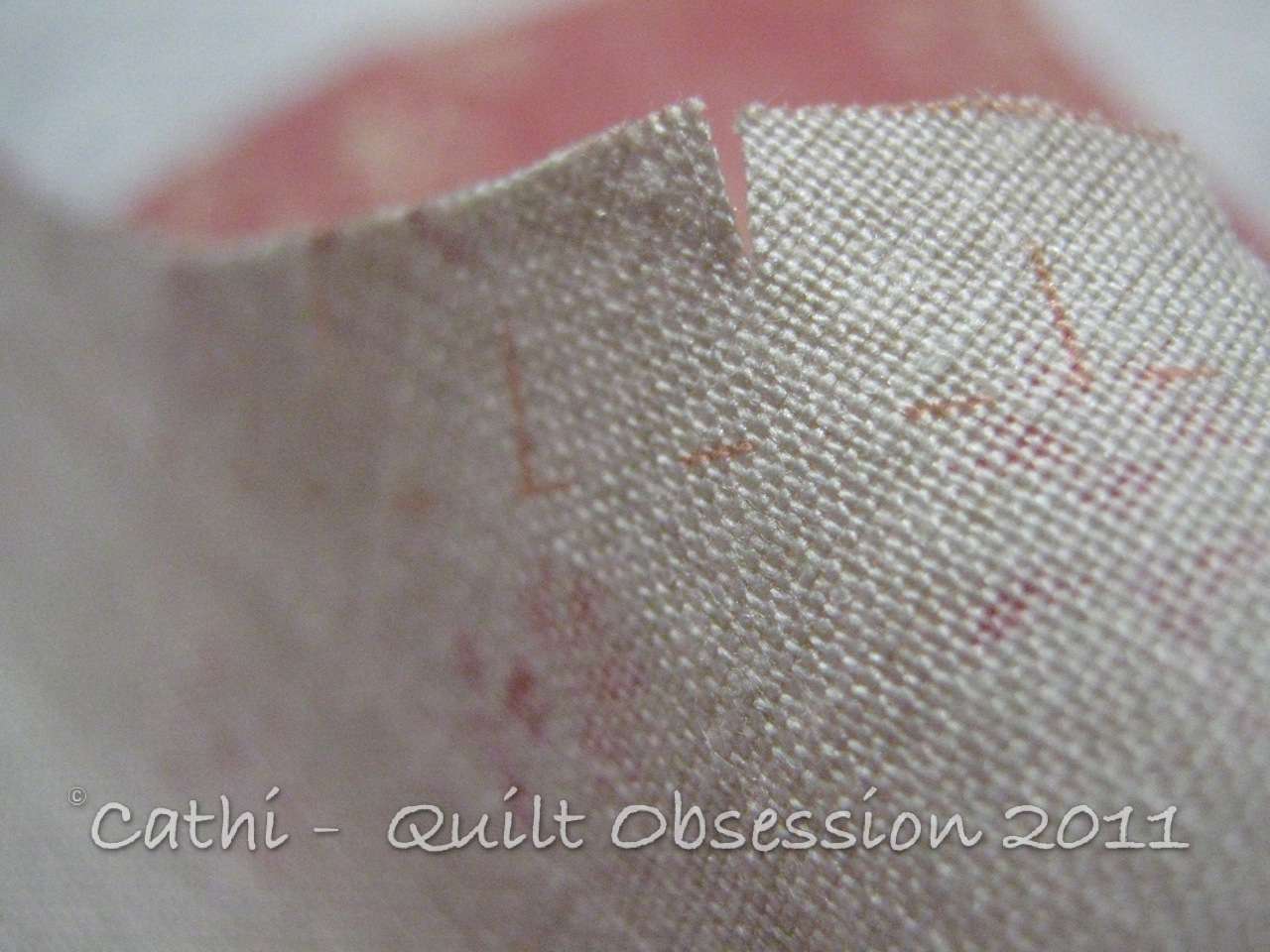
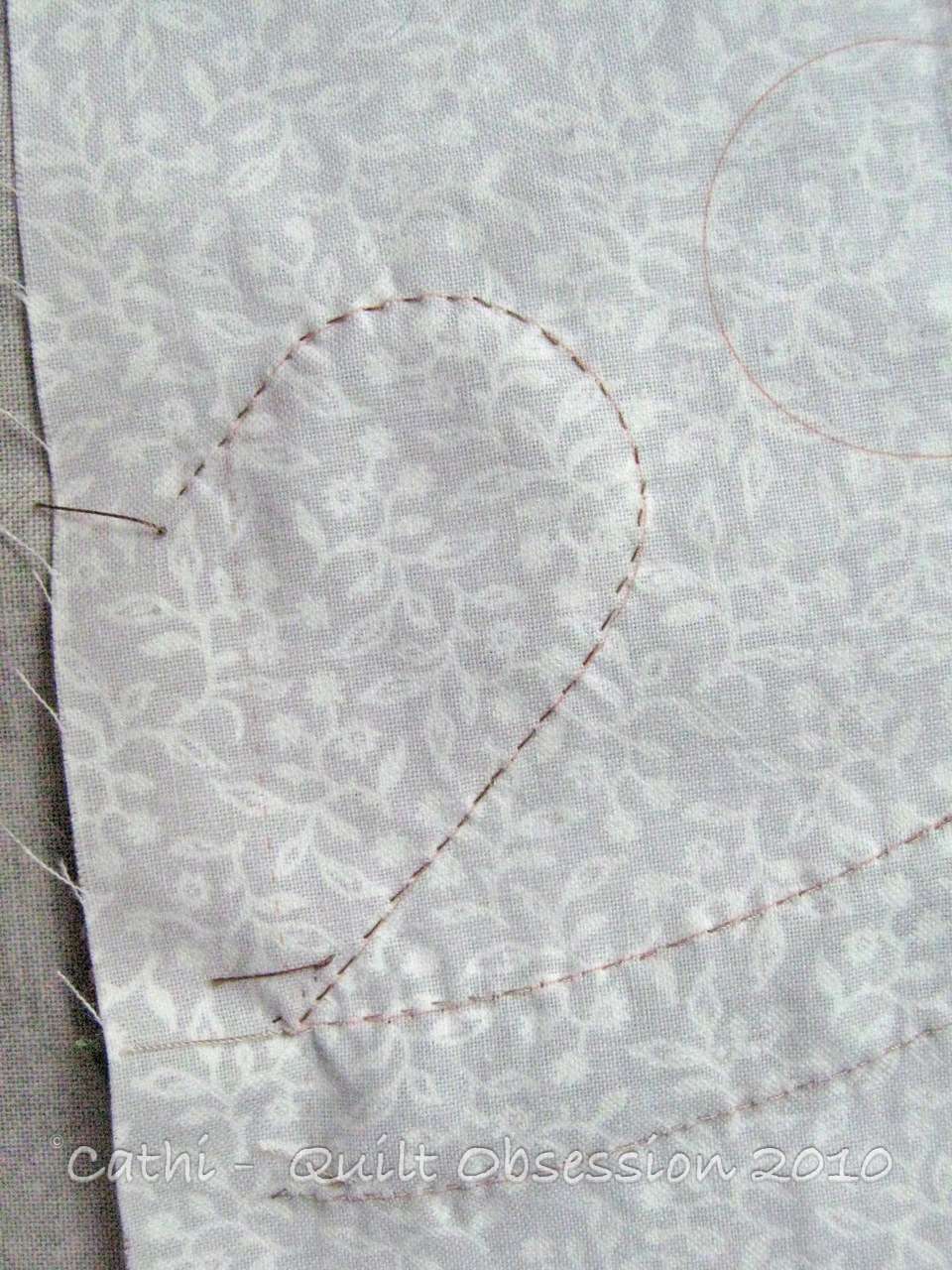
The first thing step is clipping slightly into the seam allowance of the piece with the concave curve.  You can see one clip in this picture.  I clip between every matching point that’s printed on my fabric.  In the above picture you can see the stitching line and the matching points that have printed on to the back of my fabric.

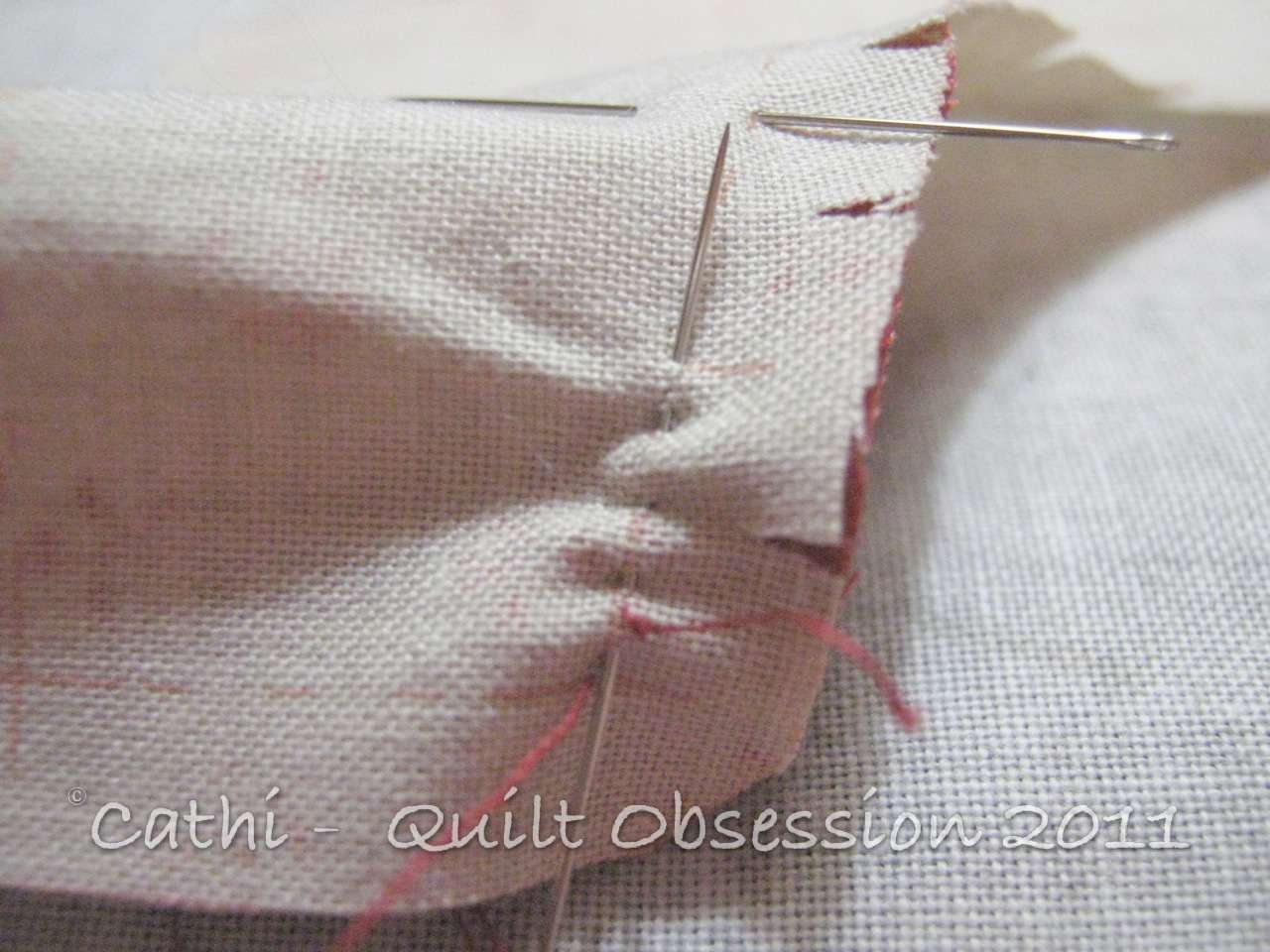
Then I line up the pieces and, using #12 sharps as pins, pin the first and second matching points.  I pin the first to hold it in place when I insert the threaded needle a bit over from the beginning of the seam.

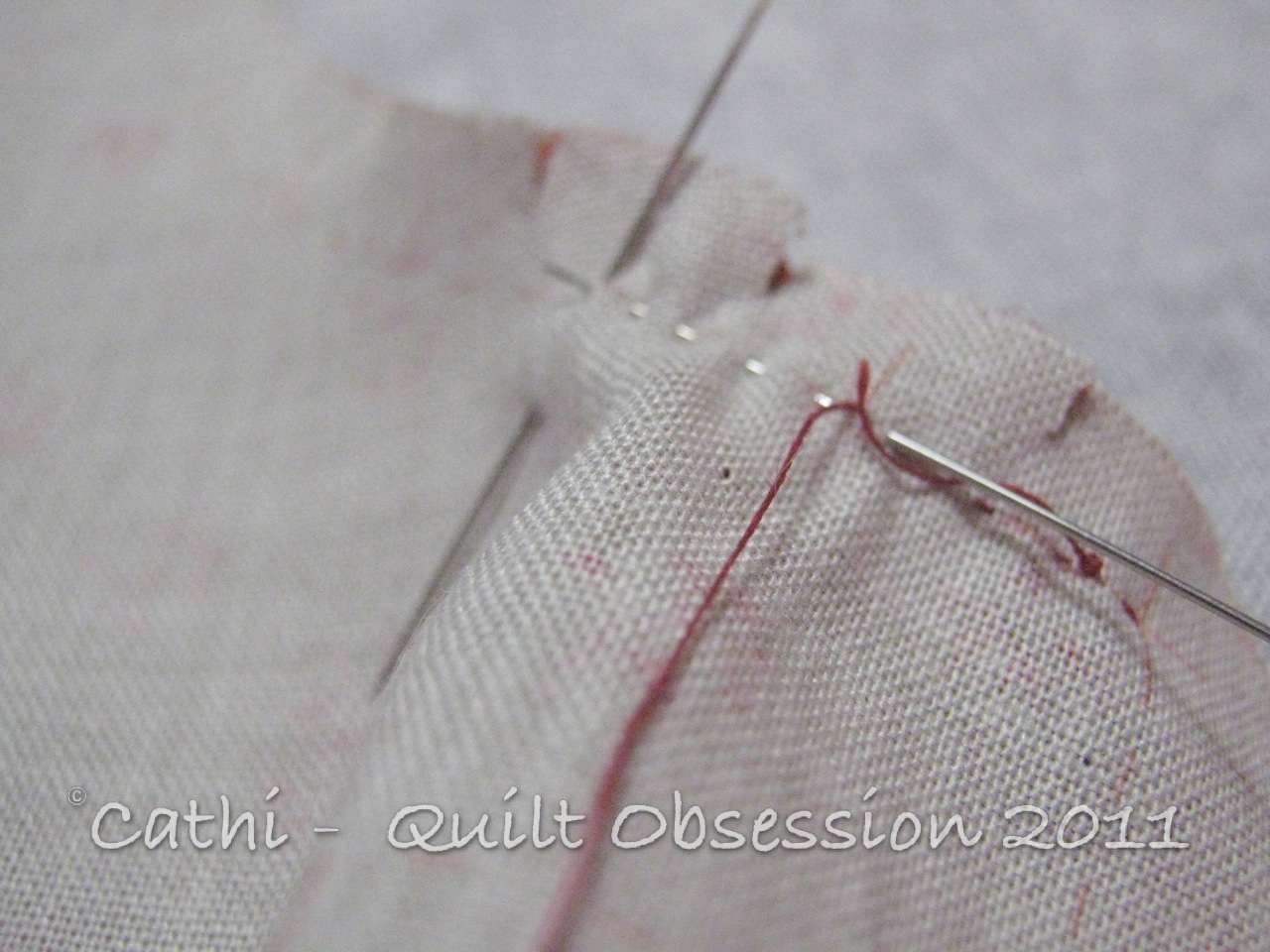
Then I bring the threaded needle back up through the matching point at the beginning of the seam, effectively taking a back stitch.

Then, taking the smallest stitches I can, I load the needle with stitches up to the next matching point.

Before I pull the needle through, I move the sharp from that first matching point along the seam to the next.

Pull the needle through, make a small back stitch and proceed by loading the needle with more stitches up to the next matching point.  Then it’s simply a matter of repeating the last 2 steps until the end of the seam.

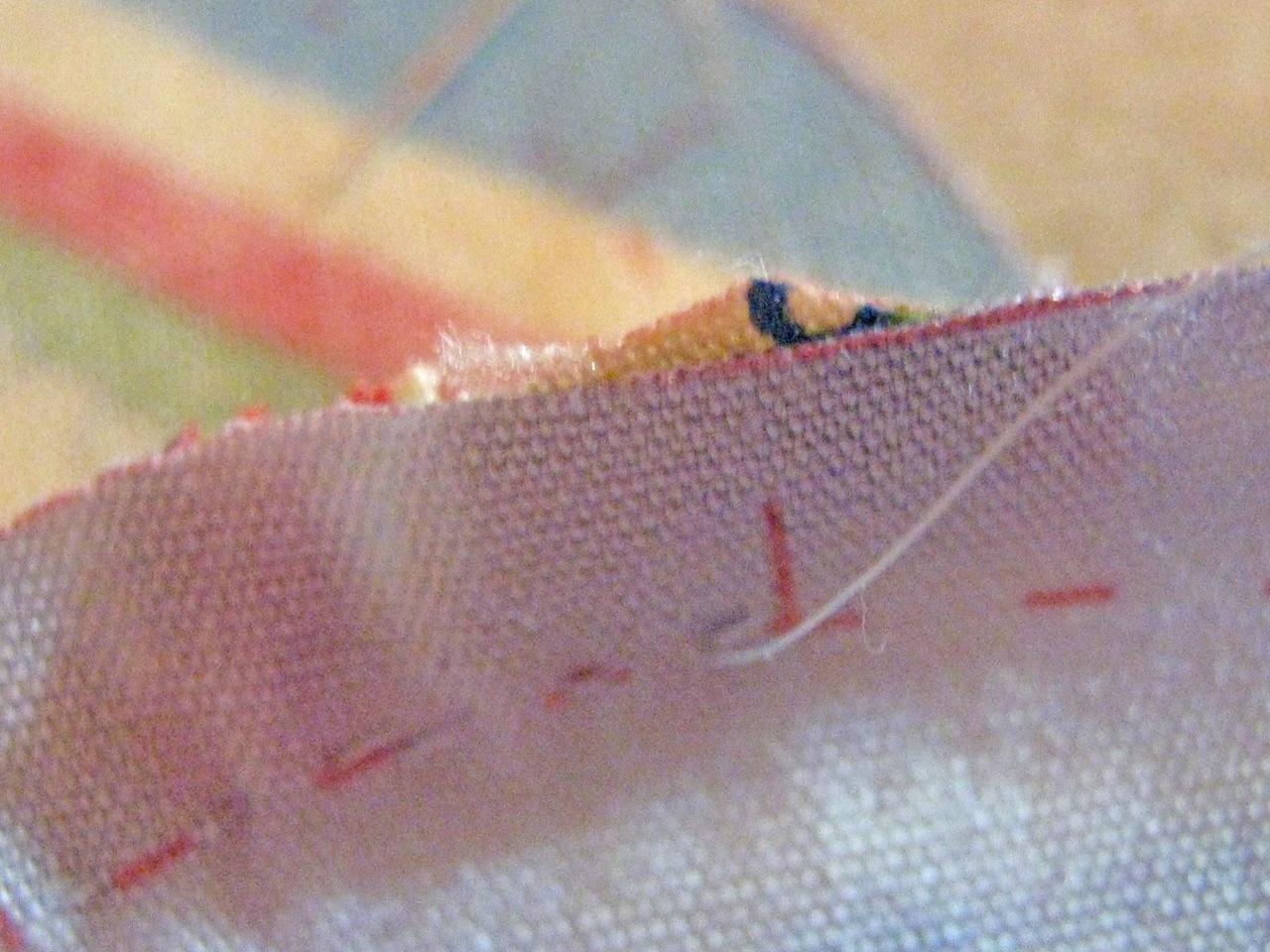
I’ve reached the end of the seam. At that point I make a back stitch, turn the piece over and make a small knot, once again away from the end of the seam so that the knot won’t interfere when adding other pieces.

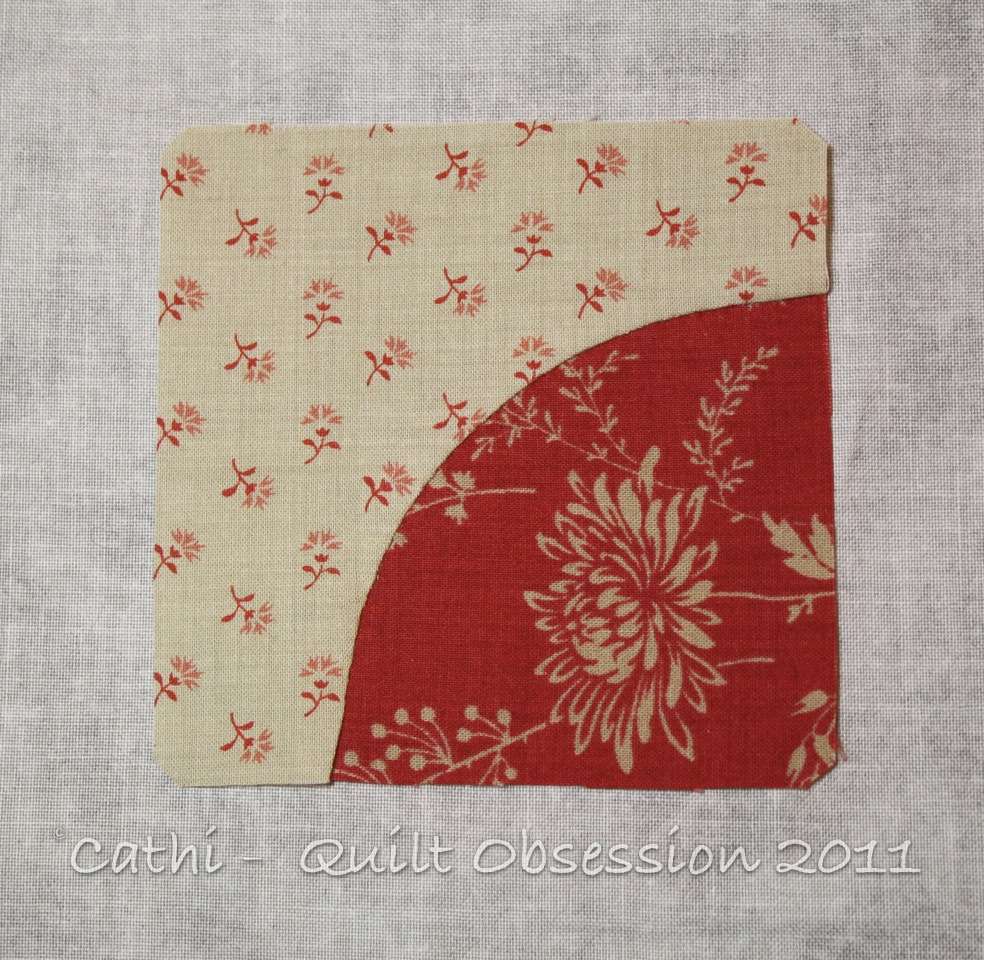
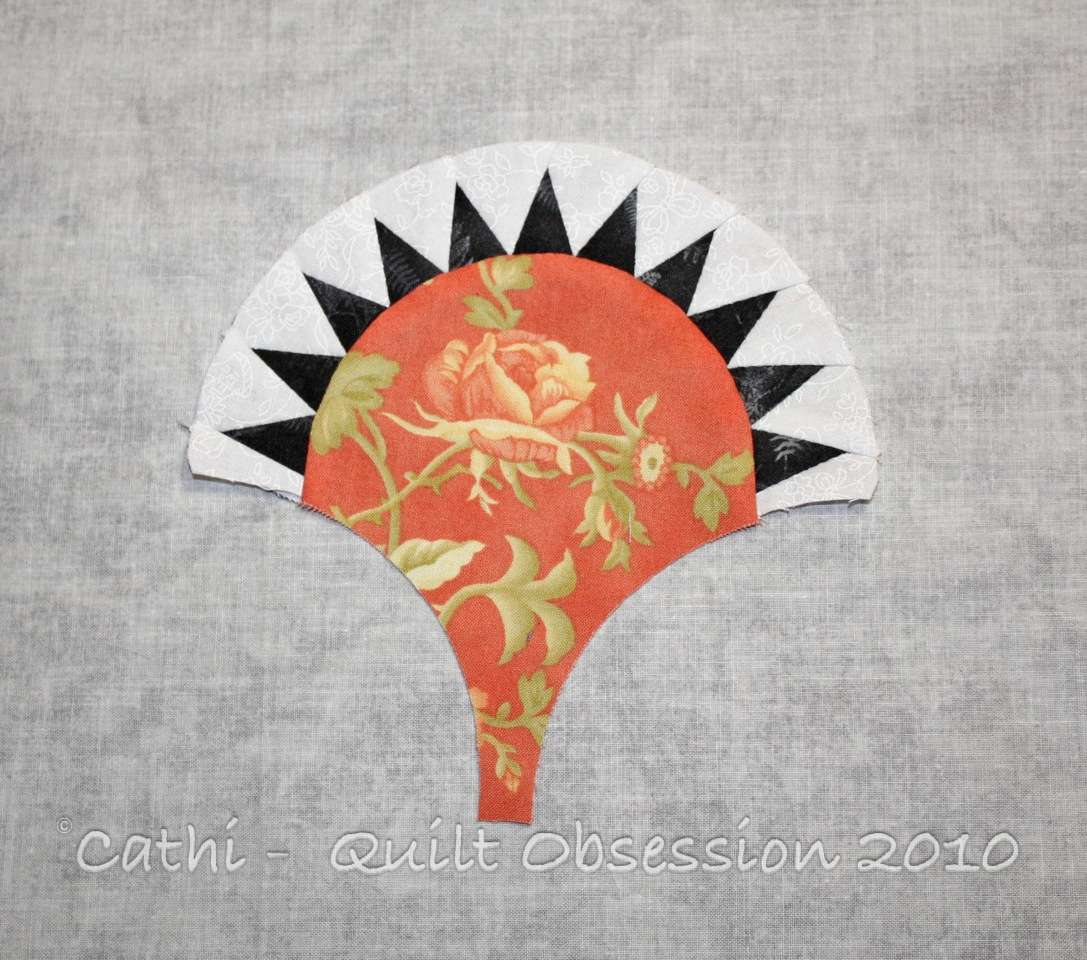
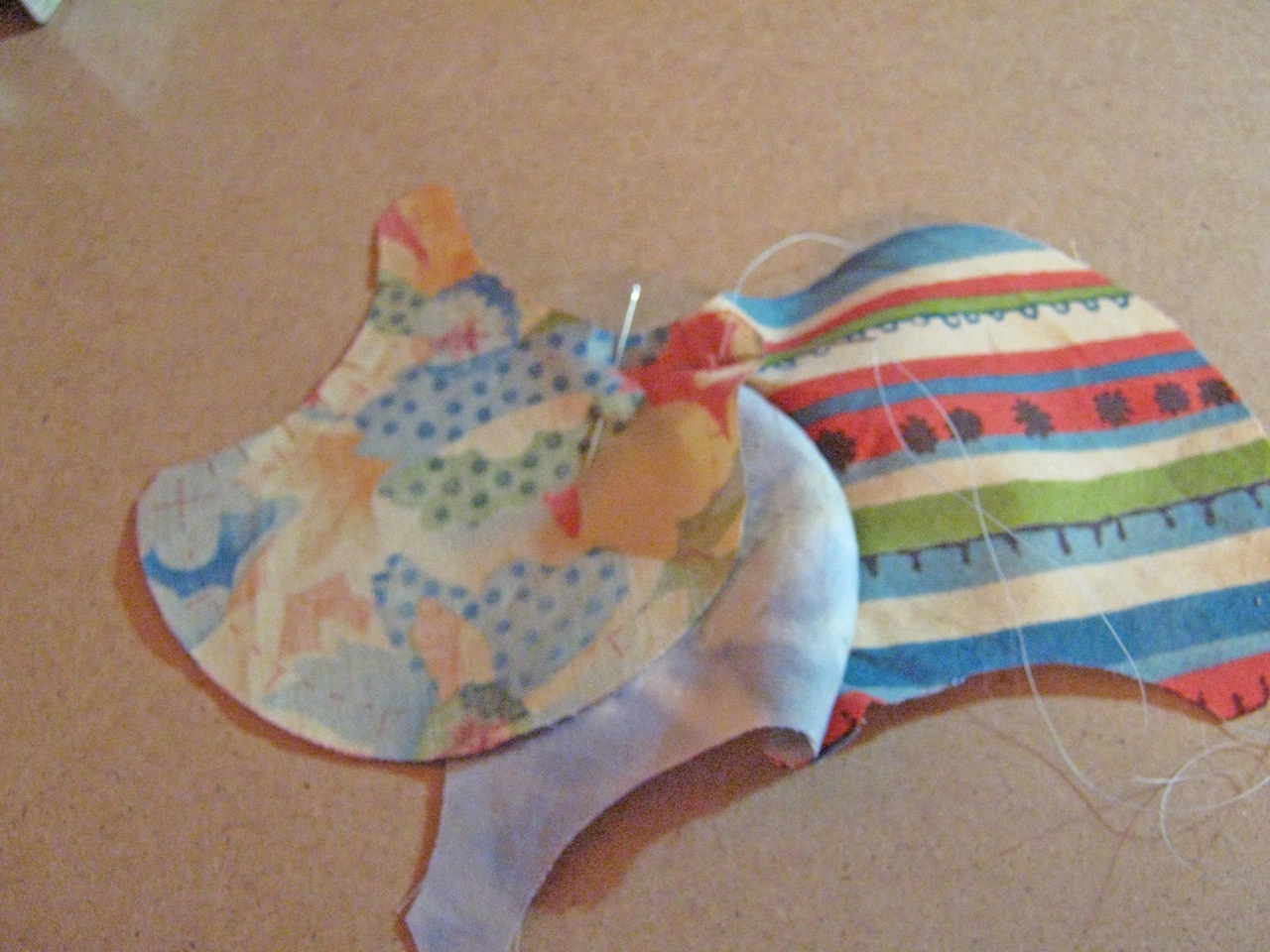
The little Drunkard’s Path unit is finished.

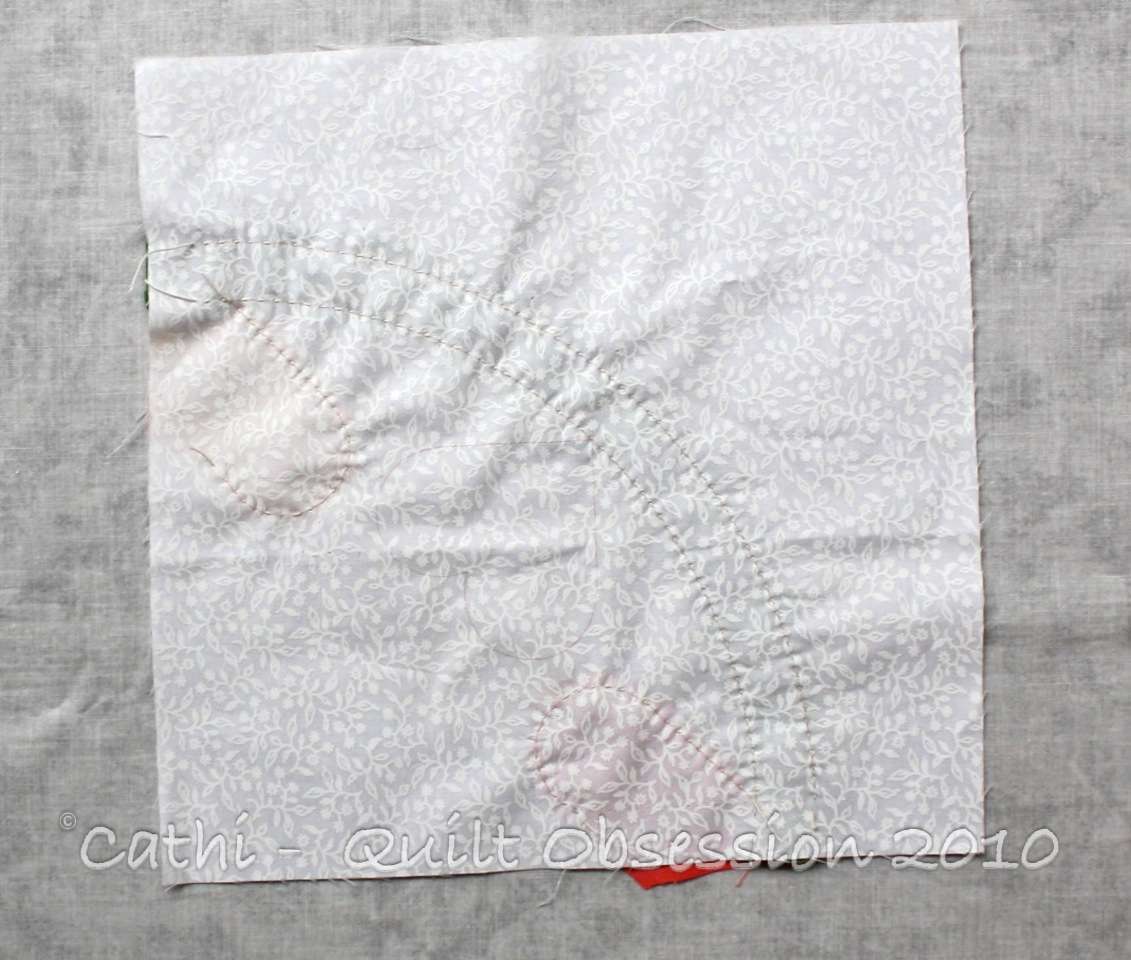
The back:

They really only take a few minutes to stitch.  For fun, I decided to see just how long it takes me to stitch one.  It’s just over 5 minutes from start to finish.

Lester hopes you found this relaxing.

The Making of a Finger Pincushion — Lots of Photos

I’ve been having fun putting these finger pincushions together and have had a few questions about the method to make them, so thought I’d do this quickie tutorial. Lester is alert and ready to watch.

Start with a 4.5″ square.   Because you’re going to be wearing this on your finger, next to your skin, I think it’s really important to wash the fabric first and get rid of the residual chemicals from the fabric manufacturing process.

Fold it in half, into a triangle shape.

Set your machine to a short stitch length.  In my case I used a 2.  Start stitching at one end of the triangle, carry on to a quarter of an inch before the end of that side, pivot and start down the other side for about an inch.  Secure and cut your thread.   Leave an area of approximately 1.5″ open and then begin sewing again and go right to the end.  This is what your triangle will look like.

This next step is optional, but I think it helps a lot when stitching the pincushion closed at the end.  I fold the two sides over, where the opening is, and then press them.  I find it makes it a lot easier and faster to do the final stitching by hand to close the pincushion.

Gently turn your triangle right side out.  Use something like That Purple Thang to push out the corners and tip.   This is what it will look like at this stage.

After some experimentation, I’ve found that using a combination of batting scraps torn up and some polyester filling to stuff the little pincushions makes them firm but not too firm.  Using only batting scraps can result in rather lumpy pincushions.  I start out with a large handful of the polyester fill and some batting scraps.  Almost all of what’s showing in this picture will be used to stuff this pincushion.

Start by putting some of the polyester filling in, and push it down to both ends of the triangle.  Keep adding polyester filling until it’s about 1/3 full.  Then start adding some batting scraps, bit by bit.  Push them down into the polyester filling.  Then add more of the polyester filling and keep adding it and the batting scraps and pushing them down to ensure a firm pincushion.  Bear in mind that you will have to stitch up the opening in the seam and fold the ends over to make the ring, so make sure that you don’t fill it too full.  This is what mine looks like after I’ve finished stuffing it along with the few remaining scraps of batting that I didn’t use.

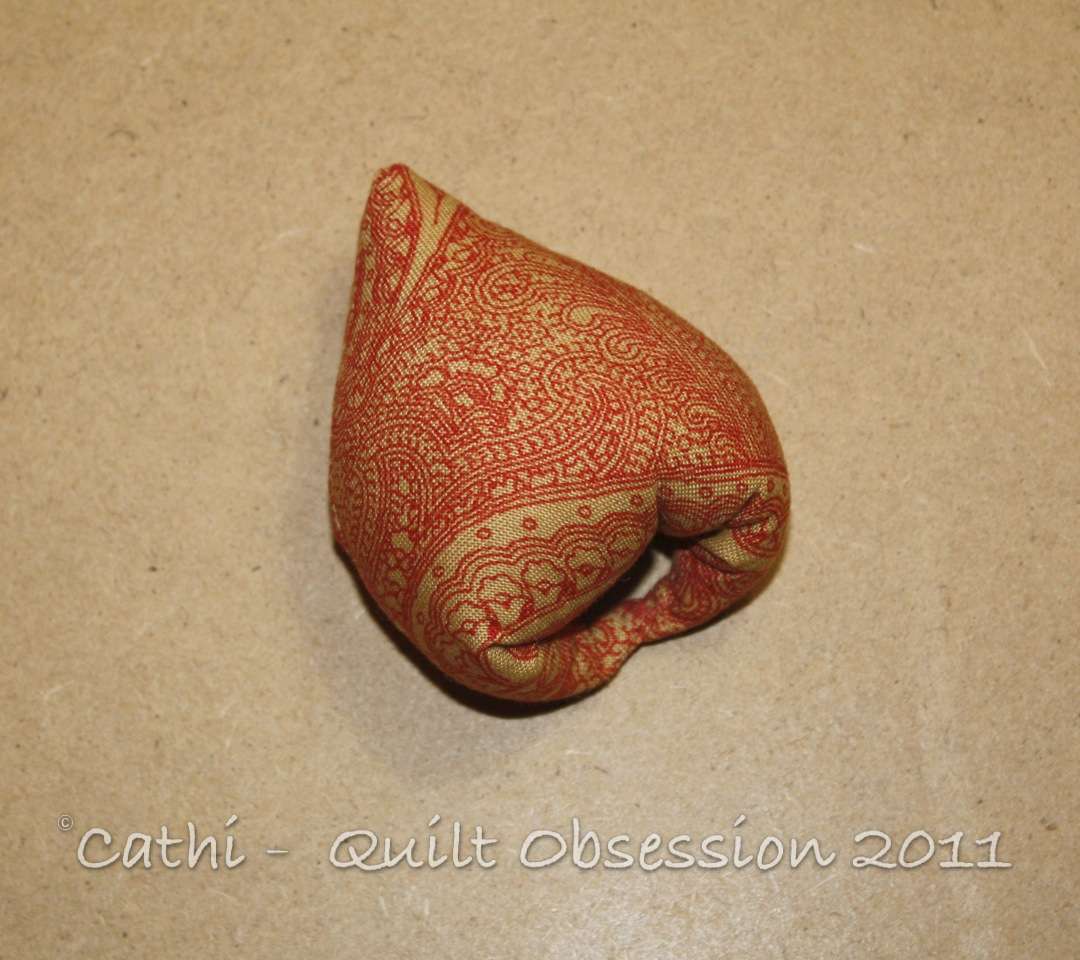
Using a very small ladder stitch or your favourite applique stitch and a thread colour to match your fabric, stitch the opening closed.  The final step is joining the two ends of the triangle together to form the ring.

Although it’s awkward, try overlapping the ends on your finger before you start stitching them together so you can get a rough idea of  how large a ring you need to leave to make it comfortable to wear on your finger.  Then just stitch to secure.

It’s a bit difficult until you get the first 3 or 4 stitches in, and then becomes much easier.  Overlap the two ends and start stitching by once again using a thread that matches your fabric.  I make a quilter’s knot, and then bury it in the pincushion stuffing, much like you’d bury your knot when beginning to quilt.  Bring the needle out at one of the ends and start stitching them together.

Try to stitch around both ends; the one that ends up on top and the one beneath it. It’s rather difficult to get a decent picture of the joining, but I hope you can see that I’ve basically tacked the ends down by stitching around them.

Next step?  Start using and enjoying your new finger pincushion.  But make yourself a couple because, once you get used to using these, you will never want to be without one.  You might just want to make a few for friends too.

Or you could contact Just Jennifer, and buy some of these pincushions directly from her.  I understand that her company will have a booth at the Paducah show in April.

Smudge found the whole thing so relaxing that he stretched out!

Carpenter’s Wheel — Lots of Photos

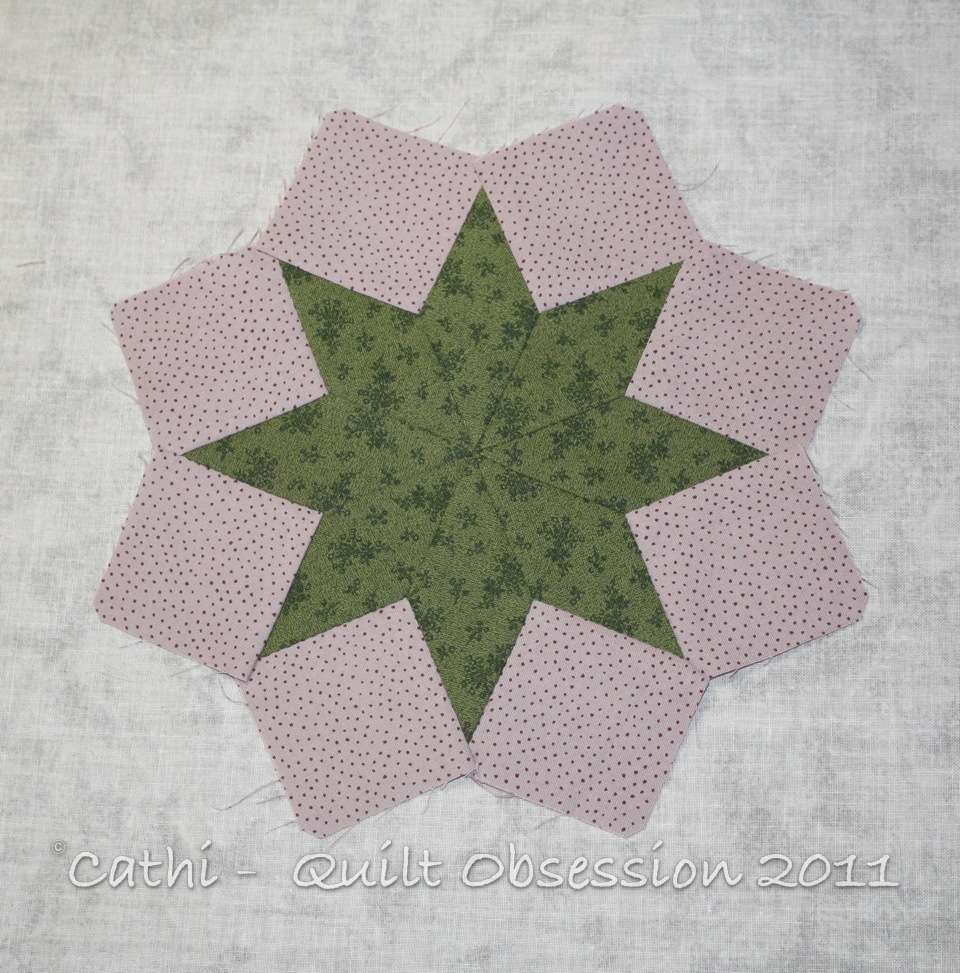
A friend asked me how I’d make one of the Carpenter’s Wheel blocks so I decided to do a mini tutorial on it.  Smudge is watching intently.

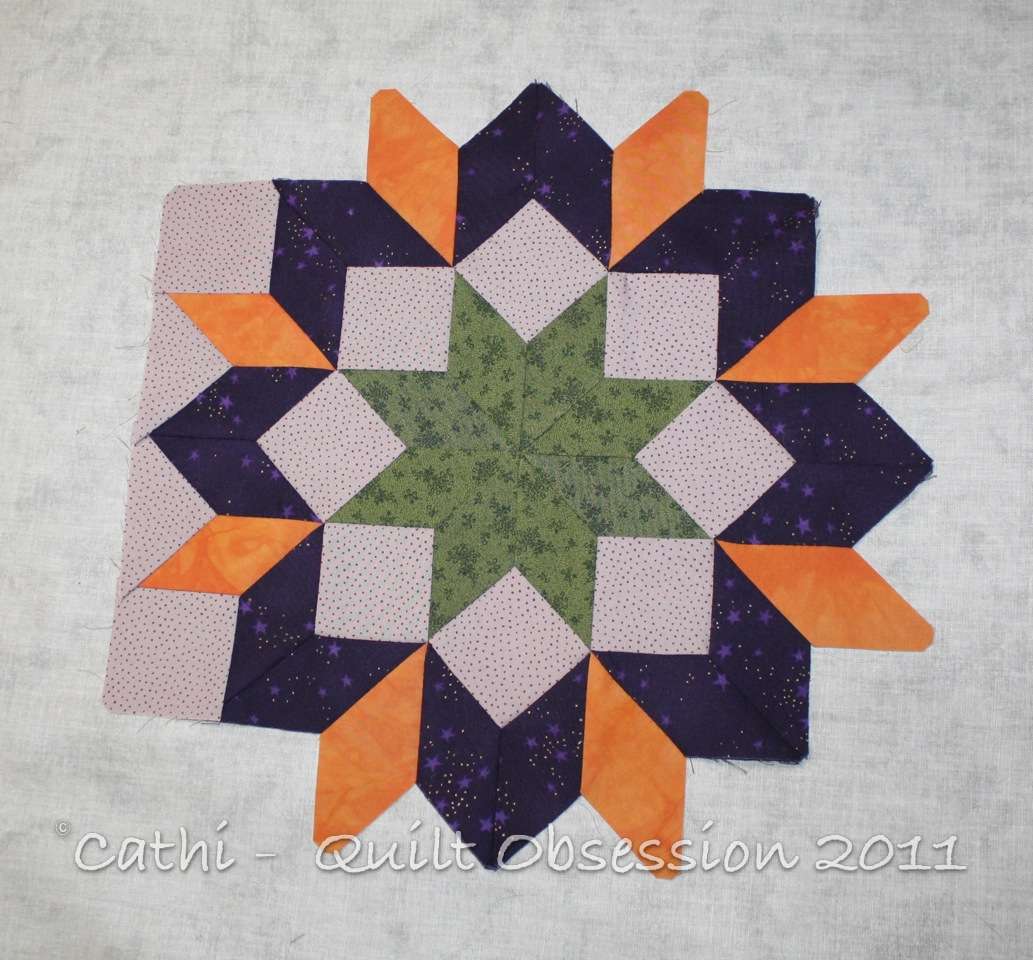
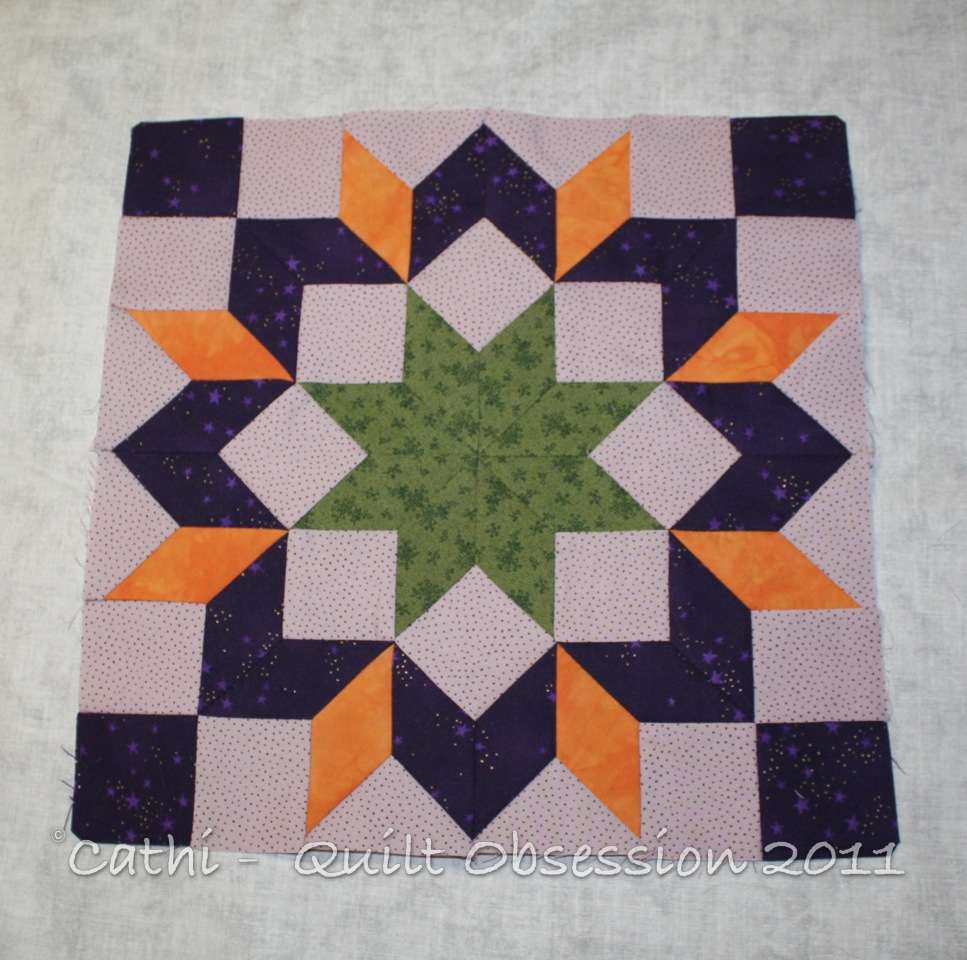
The first thing I did was figure out what I needed to print, which was 8 diamonds for the centre star, 8 squares in the background fabric to surround the centre star, a total of 24 other diamonds for the frame around the star/square centre,  8 QSTs and 8 more squares in the background fabric, and 4 squares in another colour for the corners.  Once that was done, it took only minutes to print and then cut out my pieces.

The first step was to make the centre star.

The next step is to add the 8 squares around the centre star.  As I hand piece, I look for these continuous stitching possibilities.  Two lengths of thread later and all the squares were added.

Pressing after each round isn’t normally something I do, but this time I did.

The next step is to make the frame of diamonds that will surround the centre star/squares.  As I was using two colours, I first stitched the purple diamond pairs and then added the orange diamonds in between and continued joining them until I had the frame ready.

Another opportunity for lots of continuous stitching and a few threads later, the frame is added.  In fact, it went so fast that I had started to add the final squares and QSTs around the block before I remembered to take this picture.

The final step is to add the background squares and QSTs around the perimeter. Again, lots of continuous stitching.  When adding the squares and QSTs, I left the corner squares until the end so that I could take advantage of the continuous stitching opportunities and then went back and added the 4 final squares.

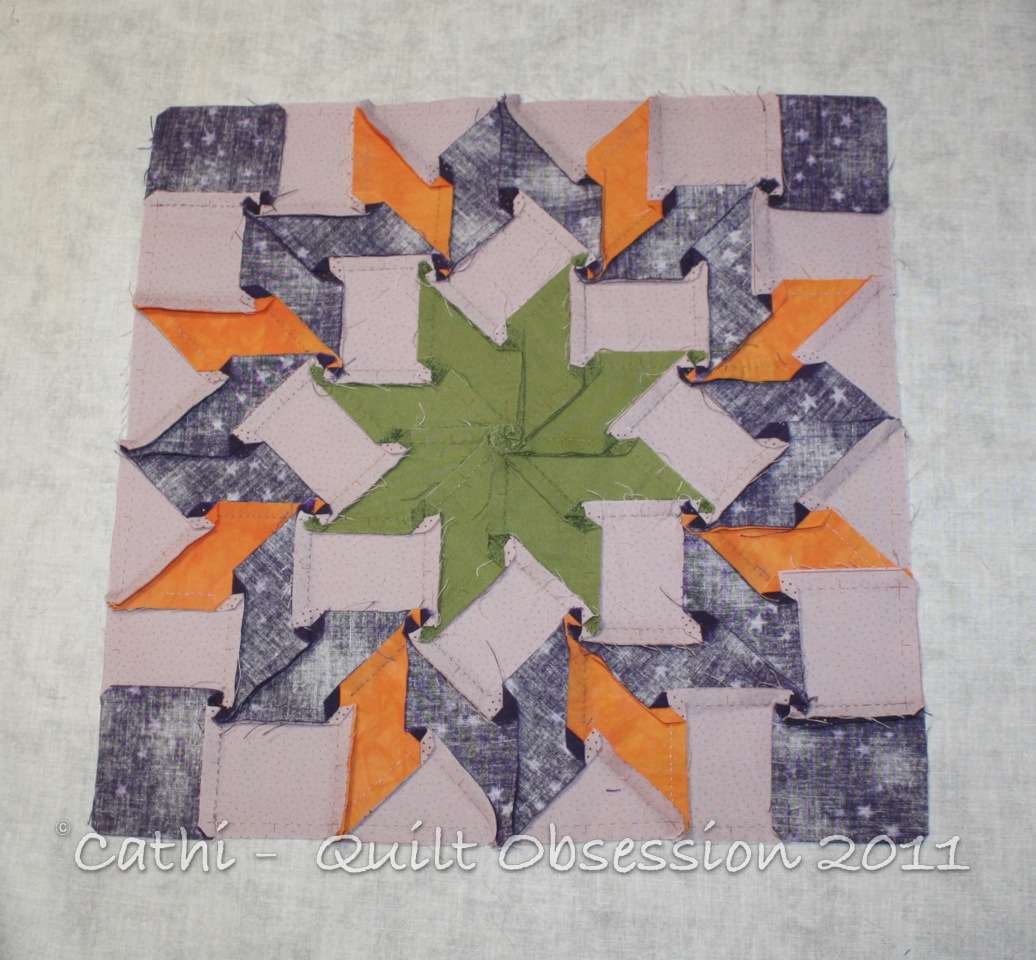
It presses beautifully and lies flat as can be.  Because of the perfect stitching lines and matching points printed with Inklingo, making this block is not difficult at all.  I used the 6 inch LeMoyne Star collection to make my block, which finishes at 12″.

The fabrics I used for this block really had me out of my normal comfort zone as far as colour goes.  It was interesting stitching and now that it’s done, it’s on its way to a friend.

Lester found this whole thing so relaxing that he fell asleep!  He’s continuing to improve and has been playing with toys, is eating on his own and seems more like himself every day.

Piecing a Seven Sisters block — lots of photos

There were a couple of questions last week about how I pieced a Seven Sisters block so, rather than try to explain it in words, I thought I’d do this mini tutorial.  Lester is hoping this is relaxing and easy to follow.

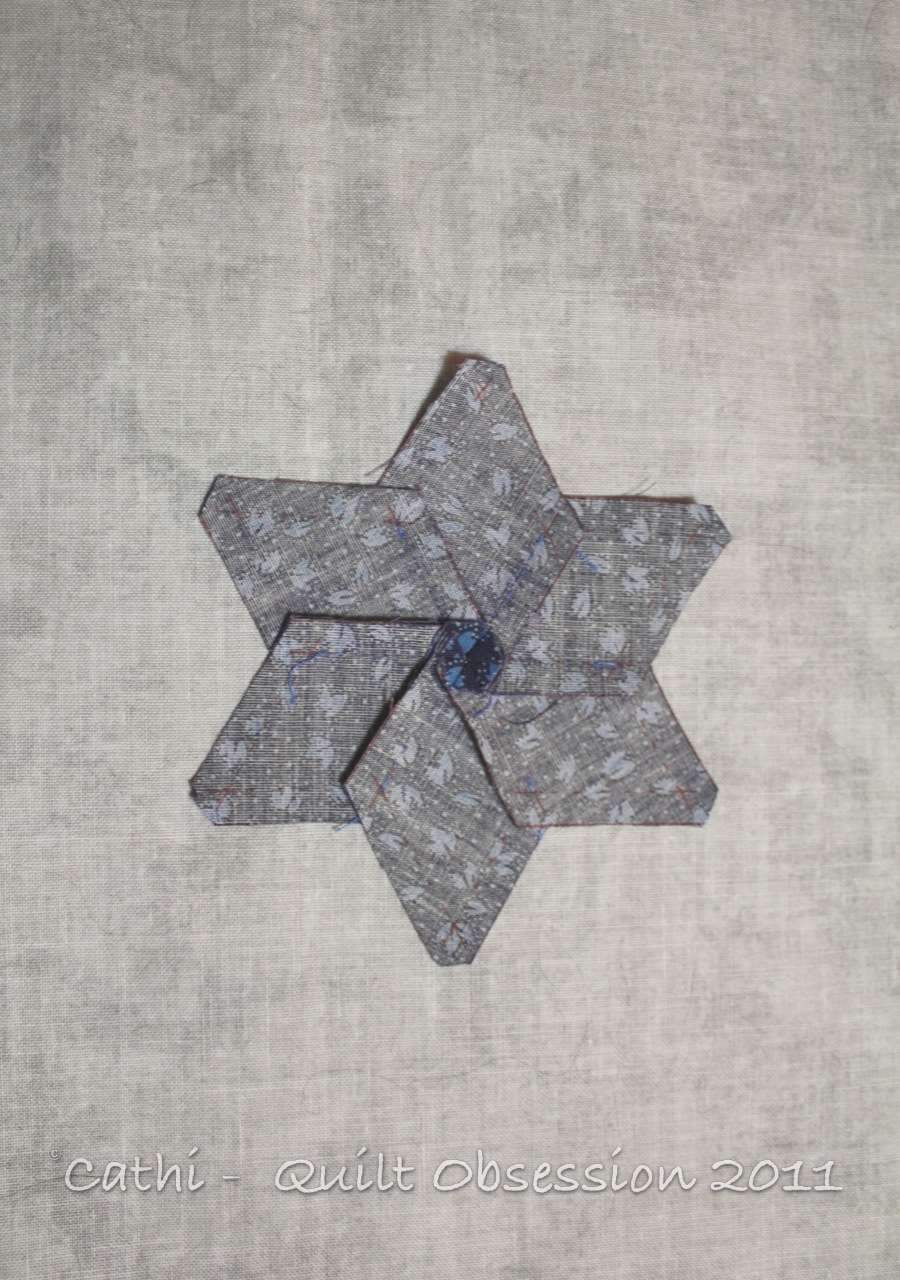
The first step is to make the seven 6-pointed stars that will be in the block.  For each block, I need 18 white diamonds, 6 half elongated hexagons and 42 blue diamonds for the seven stars.

Once that’s done, the next most important step is to press them making sure that the seam allowances of each star are pressed the same way.  This photo is of a star in a different fabric, which shows the seam allowances a bit better.

My next step is to surround one star, which will be the centre star in the block, with white diamonds.

Because I hand piece, the inset seams are something I look for as it offers the opportunity to continuously stitch around the star.  To add the six white diamonds around the blue star, I used one length of thread.

In this photo you can see, on the white diamonds and half elongated hexagons, that each has the stitching line and crosshairs at the end of each seam.  The lines are printed on my blue fabrics as well, but they don’t photograph as well.  Because of the perfect  stitching lines and crosshairs one gets when printing templates on to the fabric using Inklingo, it makes stitching a block like this a breeze.  I simply match up my crosshairs, pin and stitch.

My next step is to join the six remaining stars with white diamonds so that they’re ready to stitch to the centre star.

Then I pin the first of the strip of six stars to one of the white diamonds surrounding the centre star and start to stitch.  Again, lots and lots of continuous stitching.

A couple of threads are all it takes and the centre star is completely surrounded.

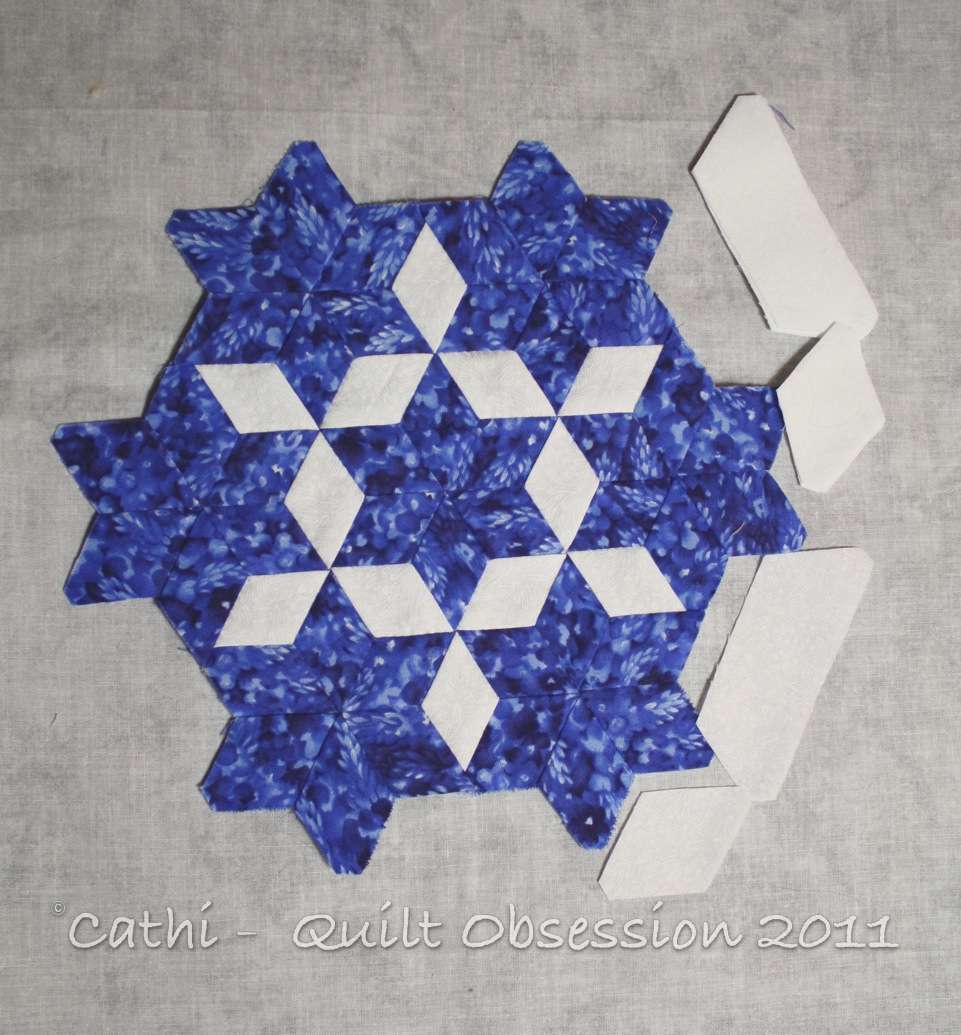
All that’s left to do now is add the six remaining white diamonds and six half elongated hexagons around the outside edge and the block will be done.  Once again, lots and lots of continuous stitching.

The block is finished.  While I didn’t really keep track of the time it took to make the block, I think that it took somewhere around 3 hours in total from making the seven stars to adding the final white diamonds around the outside of the block.

A quick press and it’s ready to be added to the stack of the blue and white Seven Sisters blocks that I am making.

Smudge hopes you found this as relaxing as he did.  He had to go curl up with some softies and have a nap!   He had lost a pound again when we went to the vet.  So we’re continuing the syringe feeding for now and have gone back to the vet-suggested foods.  Sunday night he finally started to eat hard food again for the first time in two months.   We were really encouraged to see that.

Fussy Cutting/Printing – Lots of Photos

There have been a few questions about how I fussy cut and print the florals for the Pickled Lady blocks so I thought a short tutorial might be the best way to describe the method I use.   Lester is watching rather intently.

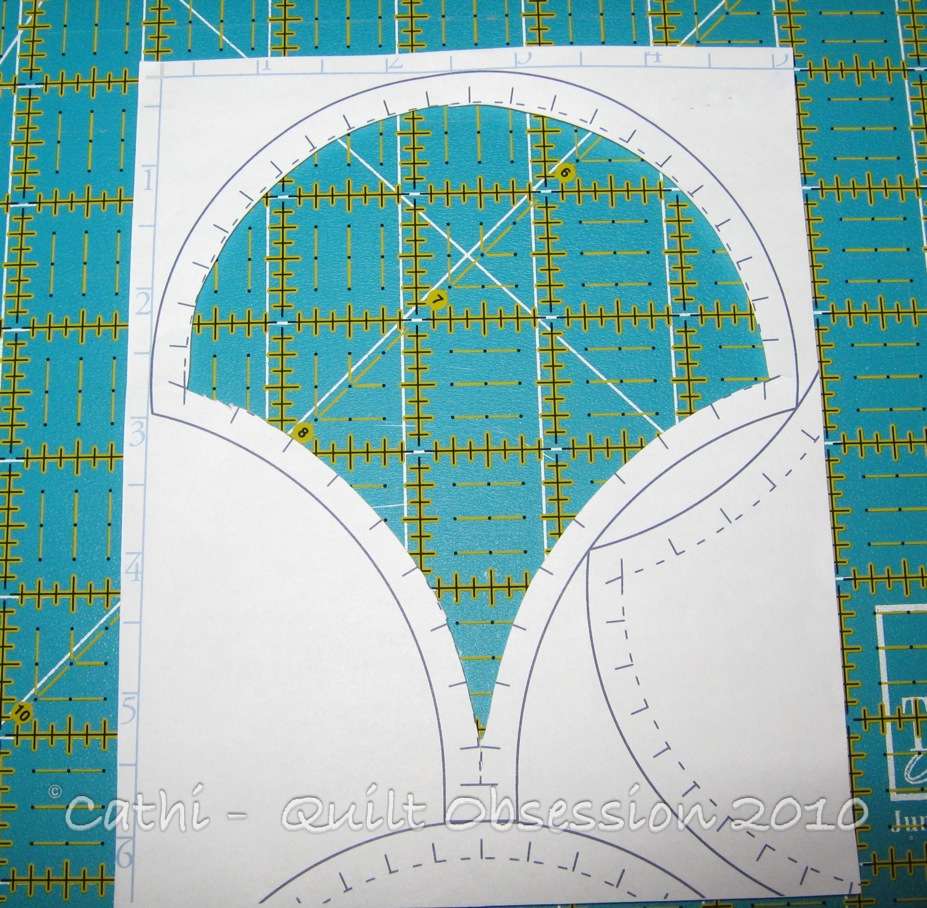
When I decided to make the Pickled Lady blocks, the first thing I did was print one of the clam shapes on a piece of plain paper which I had cut to the size I would be using.  Once that was done, the interior of the shape was cut out along the stitching line and I had my window template.

I identified a few flowers on this piece of fabric that were going to be perfect for fussy cutting.  Once that’s done, I start looking for one of the flowers that’s near the edge of the fabric.

This is where the window template comes into play.  Once I’ve found a flower that I want to fussy cut, I place the window template over it and move it around until the flower is in the centre of the clamshell.

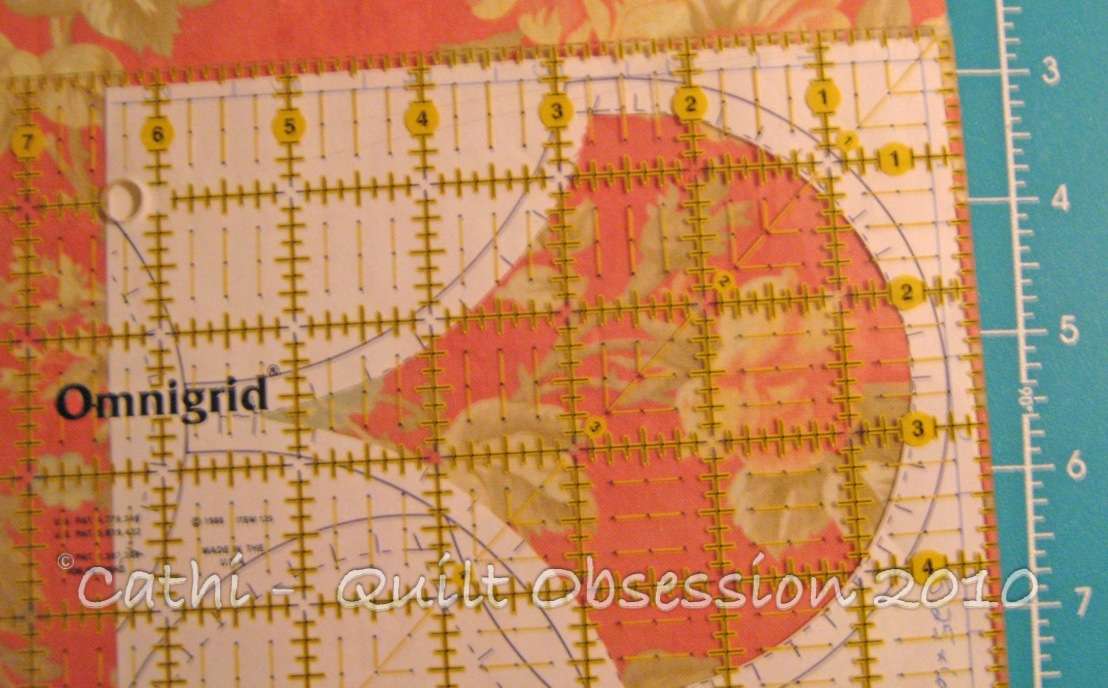
If you look closely at this shot, you’ll see that I’ve got the quarter-inch line on the ruler placed on the printed ruler line on the paper.  When I cut out my window template, I cut off about an eighth of an inch along two of the edges of the paper so that I could use the printed ruler line on the paper to line up with rather than trying to line up the edge of the ruler with the edge of the paper.

Here I’ve cut along two sides of the fabric, once again using the quarter-inch line on the ruler lined up on the printed line on the fabric.  The printed line is directly above the cutting line of the shape and that gives me the perfect placement when it comes to ironing the fabric on to freezer paper and getting it ready to print.

The selvedge is still attached.  I leave it on when I’m fussy cutting as sometimes there will be a flower at an edge that I want to use and I will need a sliver of it to have a large enough piece to iron on to the freezer paper.  I know it will be cut away once the shape is printed, so I don’t worry about it.  In this case, the majority of the selvedge will be cut away even before pressing it to the freezer paper.

Once I’ve cut the top and right side, I remove the window template and cut the bottom and left side of the fabric piece.  At that point, all I need to know is the size of freezer paper I’m using to cut the fabric to the right shape.  Then it’s simply a matter of pressing it on to the freezer paper and printing my shape.  Here you can see that while the selvedge was still attached, once I cut out my shape there will be none of it left.

Once that’s done, it takes only a minute to cut the shape out and then start stitching.  Smudge hopes you found this as relaxing as he did.  In fact, he was unimpressed when the printer started as I think it woke him up.

A bit of stitching and a  few minutes later, I had a Pickled Lady block finished to add to the stack.

The back.

Back-Basting Tutorial — Lots of Photos

Lester is intently watching as we go through the steps I take when doing applique using the back basting process.

For back basting I use both a larger needle and larger thread.

When I do any applique, my method of choice is back basting.  I’ve found a few tricks that really help me.  First of all, I use a larger needle.  In the above picture, the top needle is a #8 straw and the bottom one is a #12 sharp.  I use the #8 straw for back basting with a thicker thread, as shown below.  And I always wear a thimble when doing this as getting that needle through some fabrics, particularly a batik, requires some protection for the finger!

The thread on the left is the normal heirloom 80 weight thread I use for piecing and applique.  The thread on the right is 30 weight DMC thread I use for backbasting.

With the applique design printed on the back of my background fabric, I pin a piece of fabric that’s large enough to cover the shape to be appliqued on to the right side of the background, with the right side of the fabric to be appliqued facing up.  Then, from the wrong side of the background and following the lines, I baste the pieces on to the background fabric using the large needle and large thread and taking relatively small stitches.  Here you can see all the pieces on the quarter block basted down.  If you click on the picture to enlarge it, you’ll see the basting stitches quite clearly on the pieces to be appliqued.

This is the back and it shows the basting following along the lines of the shapes that are printed on the wrong side of the background.

What this picture doesn’t show, and I wish I had taken one after this next step, is how flat it sits after I run my nail along the lines of basting to relax any gathers that have occurred as a result of pulling the basting thread a bit too tight.  Running a nail along the stitching line is all that’s needed to ease out those little gathers.

I’ve found that leaving a piece that’s basted overnight before starting to applique it makes the next step a lot easier.  The next day I pick up the piece and clip the basting  thread at about every 5th or 6th stitch as seen in this picture.

This next step is where the magic of this technique appears. After clipping the threads, I pull out the first one or two sections. Take a look at this picture and you’ll see the perforations in the fabric to be appliqued where the basting line was.

The fabric folds along that perforation line so easily it’s always amazing to me. With my needle, I fold it under and start to applique. I don’t look at the back again where the lines are until I finish all the applique. And every time my applique stitches are close to being perfectly on the line. The reason I leave the basting stitches in overnight is that I’ve found that it makes that little perforated line really do its job. Think of it like a piece of paper that has some perforations to make it easier to remove. I think the basting line does the same thing but, in the case of fabric, makes the fabric easier to turn under.

I begin to applique, pulling out a section or two of the basting thread as I go along.  The basting thread also serves to hold the fabric being appliqued in place.  So no fighting with pins, no freezer paper to remove, no overlay to try to keep out-of-the-way and no lines that might show on the front if the applique isn’t right on the lines of the design.  Just needle, thread and fabric.

In this picture you can see how closely my applique stitches are right on the line of the design.  It also shows the lines of another shape, which I chose not to add to this part of my applique block.

Again, another picture showing how closely the applique stitches follow the line of the design.

Everyone has their favourite method, but I hope this little tutorial gives you the information you need if you’d like to try the back-basting method.

Smudge is hoping you found this relaxing and informative.

Piecing Clamshells — Lots of Photos

There are lots of pictures with this, all of which can be enlarged by clicking on them.   As seen above, Smudge was very alert and watching every step!

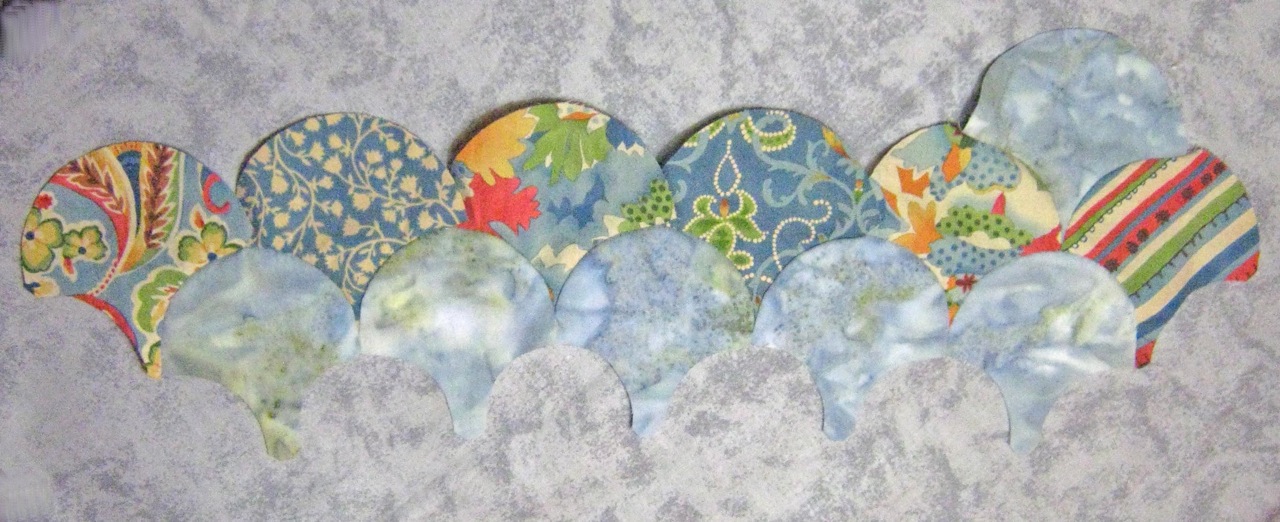
First I chose the fabrics for the first and second rows of this small clamshell project.  In this case, I’m using the soft blue/grey batik in the first row and various prints for the second row.  To begin piecing, it’s simply a matter of matching the concave curve on the second row piece to the right half of the convex curve on the first piece of the second row.

Because I printed my shapes using the new Inklingo clamshell collection, I have both matching points and stitching lines printed right on the back of the fabric, which makes piecing an absolute delight.  No tracing of templates, no fancy rulers or acrylic templates.  Just print on the back of fabric, cut out and stitch.

Before beginning to stitch, I clip the seam allowance on the concave curve — in this case, I make 2 little clips between each matching point.  The clips don’t go down to the stitching line, but rather end a few threads before it.

When I begin a row like this, I use 3 of the #12 sharps — one to pin the beginning of the seam, one to pin at the first matching point and a third needle to thread and use to stitch.  Here I’ve pinned the matching point at the beginning of the seam and the first matching point after that.
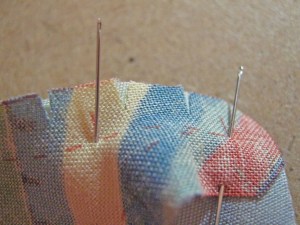
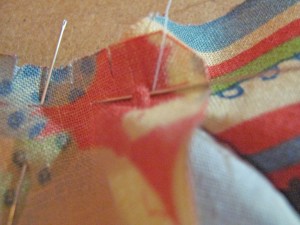
When the third row is joined, I will automatically “circle the intersection” so, in order to not have the quilter’s knot right there at the intersection, my first stitch starts a little bit to the right of the intersection.  I put the needle through from front to back, and I then come back up to the front through the matching point at the intersection.
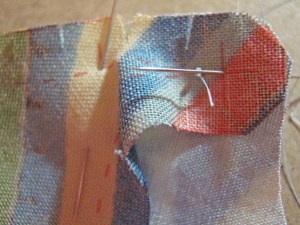
Then I stitch over to the first matching point using a regular running stitch, although on curves I do tend to take the smallest stitches I can and back stitch every 3 or 4 stitches.

Once I reach the first matching point, I then move my needle/pin to the next matching point and continue on with a regular running stitch.

Before pulling the needle through, I check the back to ensure my stitches are just above the stitching line.

Then just pull the needle through, take a back stitch, move the pin/needle to the next matching point and continue on.  When moving the pin/needle, I always check that it is right through the matching point on the back as well as the front.

And that’s all there is to it until the end of the seam.

I take the last stitch in that seam, then a back stitch and then I take the needle through again to the back of the fabric as there’s no need to knot the thread when starting to add the next piece.
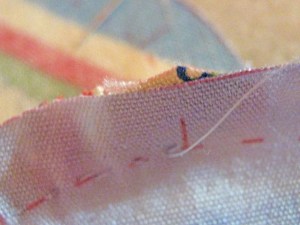
I choose my next printed piece, clip the concave seam allowance and line it up with the other half of the convex curve on the first batik piece and insert the pin/needle at the first matching point.

Then, as I’ve left the threaded needle at the back, I will be going up through the same matching point at the back but this time through the matching point on the back (batik) and the first matching point on the next printed piece.  I take the first stitch, then a back stitch and then stitch along to the end of the seam in the exact same way as the first seam.
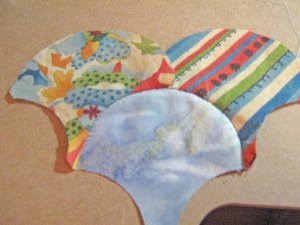
Now I have 2 clamshells in my second row added to the first clamshell in the first row.
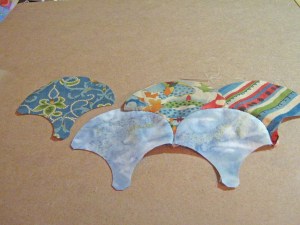
The next step is to join the second batik clamshell of the first row to the concave curve of the second printed clamshell in the second row.  I still haven’t knotted off my thread as I have enough thread on the needle to stitch one more seam.  Again, the needle/pin is inserted in the first matching point, the needle is brought through to the front, a back stitch and then a regular running stitch all the way to the end of that seam.

At the end of this seam, I will be knotting off the thread so once again, I take a back stitch and then take the needle through to the back of the seam and make my knot a few threads over from the intersection so that when I’m adding the next row I don’t have a knot in the way at that intersection.

The front view of the first two pieces of each row joined together.

And the back.  As there is a lot of bias to deal with, I don’t plan to press until I have 2 or 3 rows joined entirely.

Then I choose the print for the third piece of the second row.  The process is repeated over and over until the end of the row.
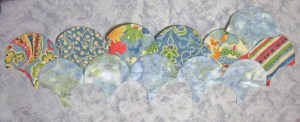
For this little quilt, my third row is all batik clamshells again and I’m clipping the concave curve of the batik pieces and stitching them to the convex curves on the print clamshells in the second row. There are lots of opportunities for continuous stitching, which I take advantage of.  To ensure there are no little holes where pieces join, I always circle the intersection at the joins.  It takes seconds to do and, once you get into the habit of doing that, it becomes second nature.
Lester hopes this was easy to follow and didn’t put you to sleep!