

There are lots of pictures with this, all of which can be enlarged by clicking on them. As seen above, Smudge was very alert and watching every step!
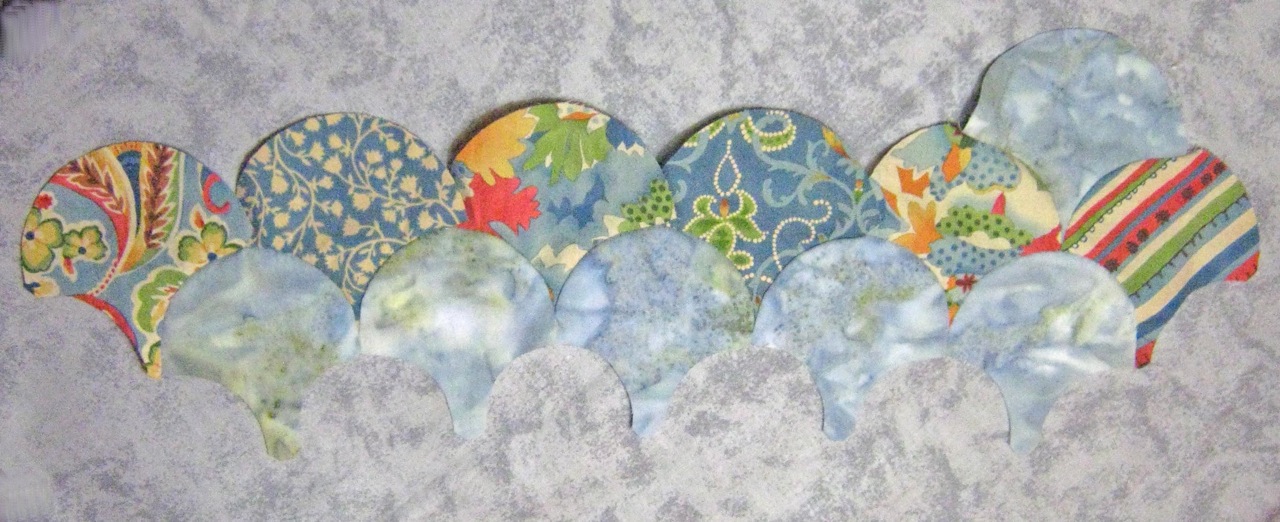
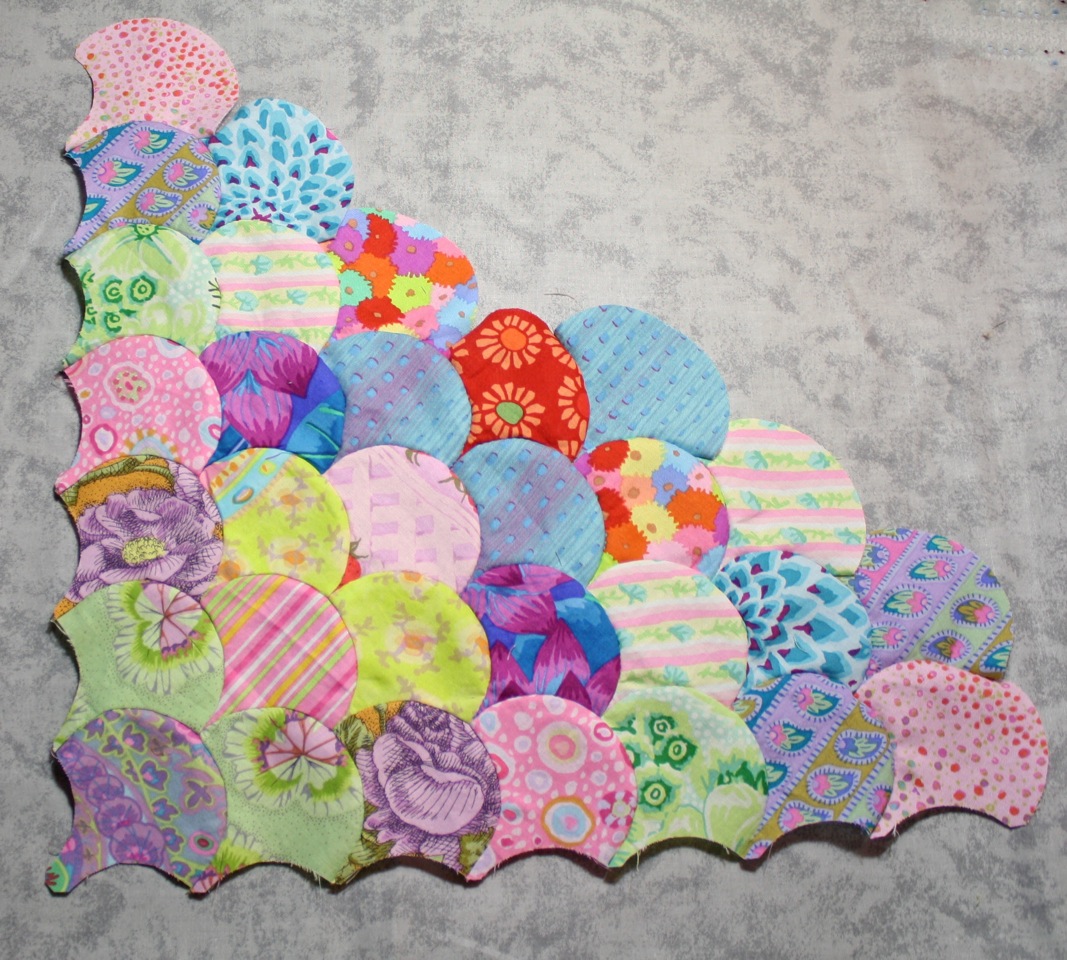
First I chose the fabrics for the first and second rows of this small clamshell project. In this case, I’m using the soft blue/grey batik in the first row and various prints for the second row. To begin piecing, it’s simply a matter of matching the concave curve on the second row piece to the right half of the convex curve on the first piece of the second row.

Because I printed my shapes using the new Inklingo clamshell collection, I have both matching points and stitching lines printed right on the back of the fabric, which makes piecing an absolute delight. No tracing of templates, no fancy rulers or acrylic templates. Just print on the back of fabric, cut out and stitch.
Before beginning to stitch, I clip the seam allowance on the concave curve — in this case, I make 2 little clips between each matching point. The clips don’t go down to the stitching line, but rather end a few threads before it.

When I begin a row like this, I use 3 of the #12 sharps — one to pin the beginning of the seam, one to pin at the first matching point and a third needle to thread and use to stitch. Here I’ve pinned the matching point at the beginning of the seam and the first matching point after that.

When the third row is joined, I will automatically “circle the intersection” so, in order to not have the quilter’s knot right there at the intersection, my first stitch starts a little bit to the right of the intersection. I put the needle through from front to back, and I then come back up to the front through the matching point at the intersection.

Then I stitch over to the first matching point using a regular running stitch, although on curves I do tend to take the smallest stitches I can and back stitch every 3 or 4 stitches.

Once I reach the first matching point, I then move my needle/pin to the next matching point and continue on with a regular running stitch.

Before pulling the needle through, I check the back to ensure my stitches are just above the stitching line.

Then just pull the needle through, take a back stitch, move the pin/needle to the next matching point and continue on. When moving the pin/needle, I always check that it is right through the matching point on the back as well as the front.

And that’s all there is to it until the end of the seam.

I take the last stitch in that seam, then a back stitch and then I take the needle through again to the back of the fabric as there’s no need to knot the thread when starting to add the next piece.
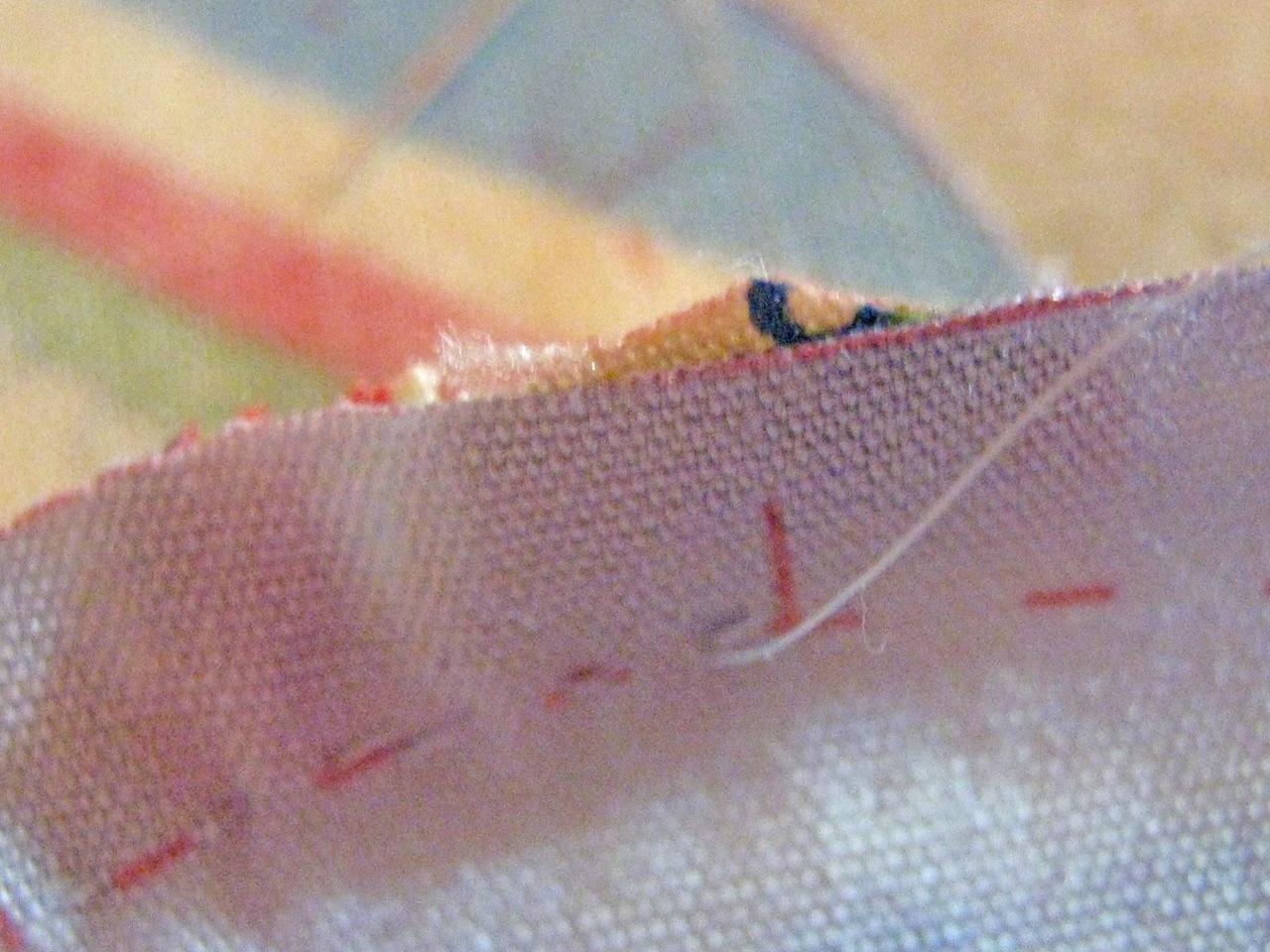
I choose my next printed piece, clip the concave seam allowance and line it up with the other half of the convex curve on the first batik piece and insert the pin/needle at the first matching point.
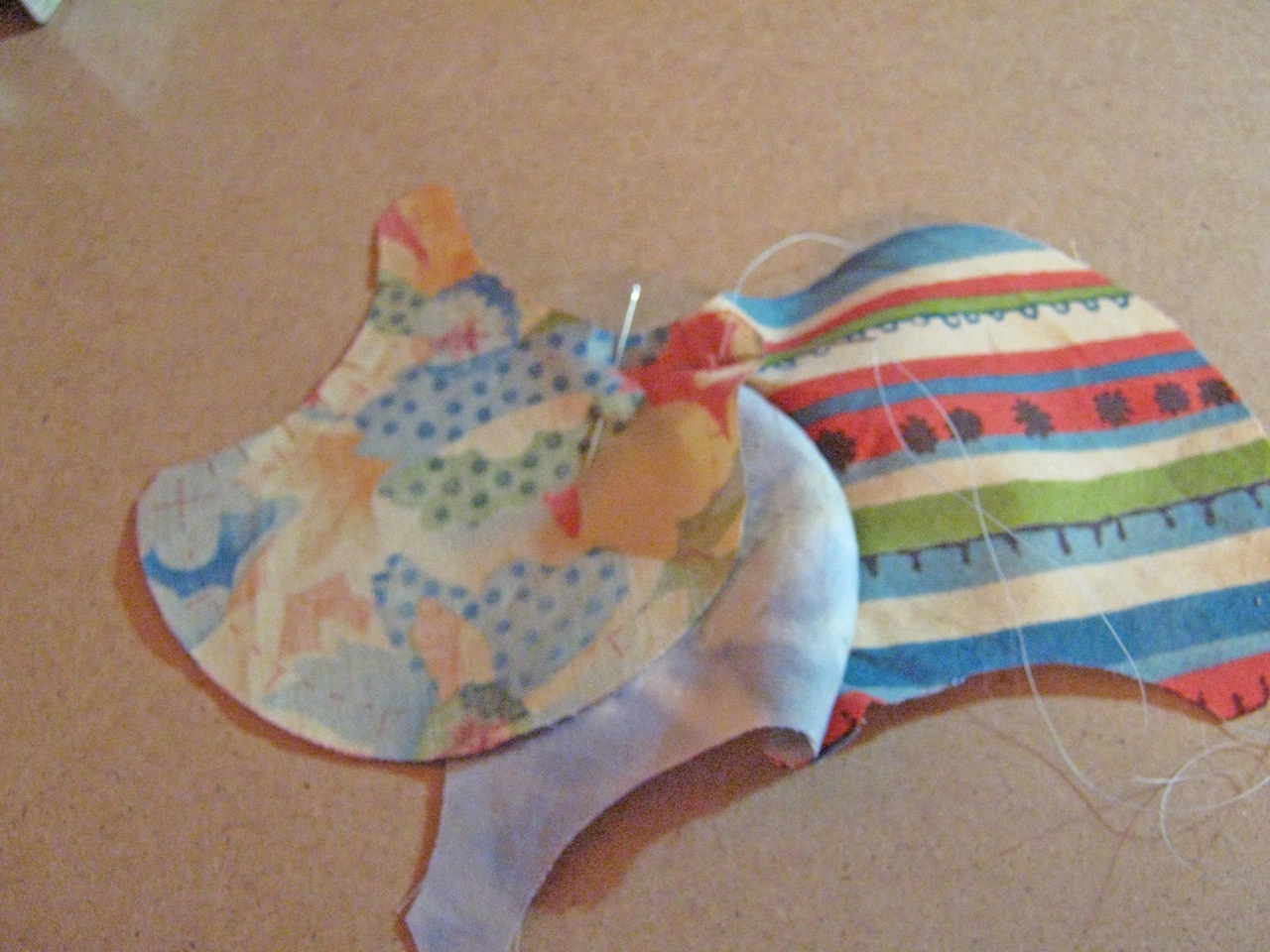
Then, as I’ve left the threaded needle at the back, I will be going up through the same matching point at the back but this time through the matching point on the back (batik) and the first matching point on the next printed piece. I take the first stitch, then a back stitch and then stitch along to the end of the seam in the exact same way as the first seam.

Now I have 2 clamshells in my second row added to the first clamshell in the first row.

The next step is to join the second batik clamshell of the first row to the concave curve of the second printed clamshell in the second row. I still haven’t knotted off my thread as I have enough thread on the needle to stitch one more seam. Again, the needle/pin is inserted in the first matching point, the needle is brought through to the front, a back stitch and then a regular running stitch all the way to the end of that seam.

At the end of this seam, I will be knotting off the thread so once again, I take a back stitch and then take the needle through to the back of the seam and make my knot a few threads over from the intersection so that when I’m adding the next row I don’t have a knot in the way at that intersection.
The front view of the first two pieces of each row joined together.

And the back. As there is a lot of bias to deal with, I don’t plan to press until I have 2 or 3 rows joined entirely.

Then I choose the print for the third piece of the second row. The process is repeated over and over until the end of the row.

For this little quilt, my third row is all batik clamshells again and I’m clipping the concave curve of the batik pieces and stitching them to the convex curves on the print clamshells in the second row. There are lots of opportunities for continuous stitching, which I take advantage of. To ensure there are no little holes where pieces join, I always circle the intersection at the joins. It takes seconds to do and, once you get into the habit of doing that, it becomes second nature.
Lester hopes this was easy to follow and didn’t put you to sleep!




 Quilt Obsession