Circle of Fractured Hearts

On Monday’s post, I showed a photo of one of the quarters of the applique I had done over the weekend.  Last night, I finally got up my courage and sat down at the sewing machine to stitch the four quarters together.  I was, as usual, practically breaking into a cold sweat at the thought of having to make sure my sewing was this precise, as my sewing machine skills are less than wonderful.  But, thanks to the fabulous lines that one can use as matching points, with a little careful pinning I was able to stitch the four quarters together and now have a circle of fractured hearts.   I didn’t have to frog stitch any of the seams!

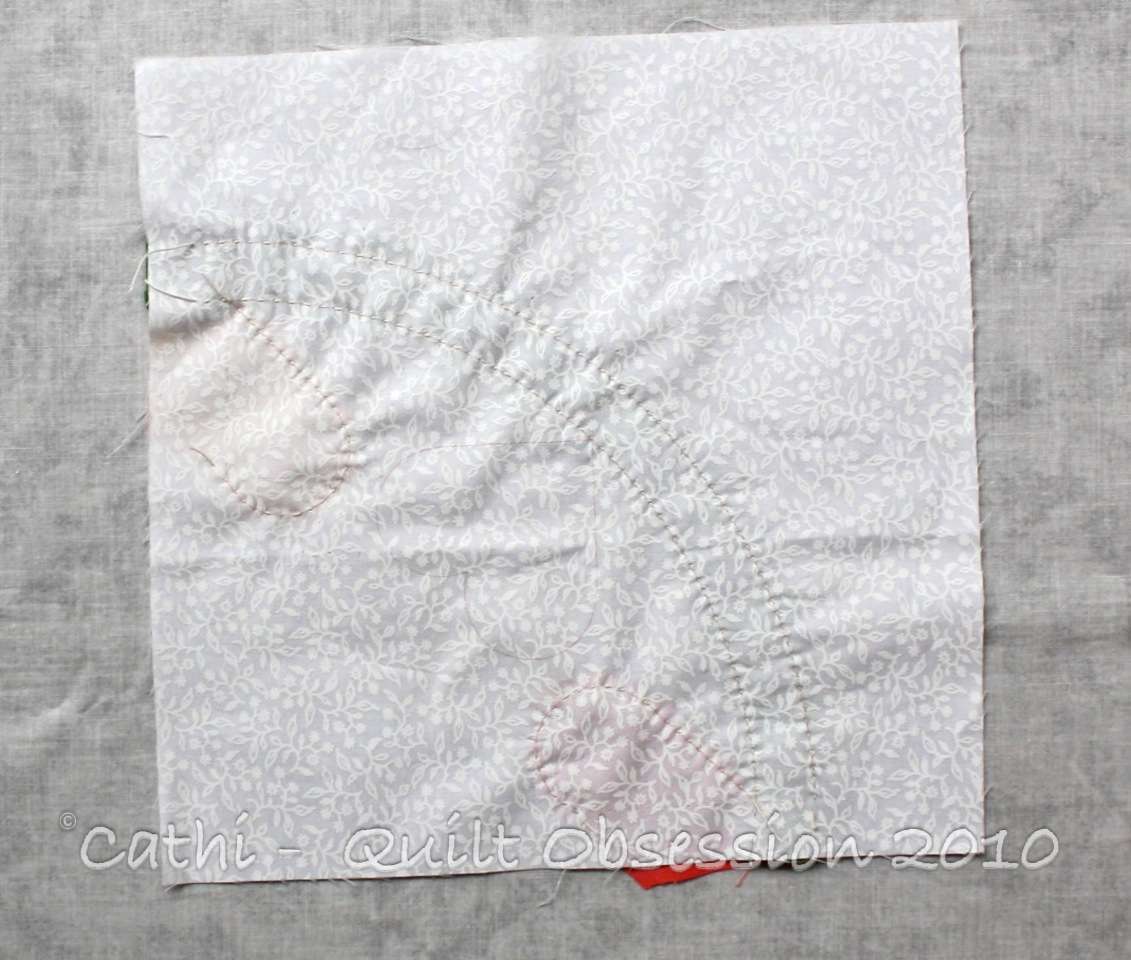
The back shows just how perfectly the lines matched up.  I don’t know that I’d want to try this with anything other than the shapes printed with Inklingo, though — as I doubt I could trace anything with this kind of precision.  In fact, I wouldn’t even want to try.  But now that I’ve got this block under my belt, I think I’m going to try one of the Celtic applique designs that are available in this collection.

One of the things I really loved about this applique block was that I set the size. I could have printed a 4″ block, a 6″ block, a 8″ block but I chose to print the design in quarters and then have a larger block that finishes at 14.5″ but I didn’t have all that fabric bunched up in my hand while I appliqued.  That’s an added value for me, as my hand will begin to hurt very quickly if I’m having to hold a large piece of fabric.

I have an idea for the fall fabrics I showed a while back using Winding Ways blocks that’s begging to be made.  I’m trying to resist but it’s getting more and more difficult.  I have so many projects on the go and so many others in the ideas book that I’d like to finish at least one before starting this.  Whether I can continue to resist the siren call of those Winding Ways blocks remains to be seen!

Lester was curled up asleep on the couch, showing us the paw pads on one of his feet.

While Smudge had taken over my desk chair.

Back-Basting Tutorial — Lots of Photos

Lester is intently watching as we go through the steps I take when doing applique using the back basting process.

For back basting I use both a larger needle and larger thread.

When I do any applique, my method of choice is back basting.  I’ve found a few tricks that really help me.  First of all, I use a larger needle.  In the above picture, the top needle is a #8 straw and the bottom one is a #12 sharp.  I use the #8 straw for back basting with a thicker thread, as shown below.  And I always wear a thimble when doing this as getting that needle through some fabrics, particularly a batik, requires some protection for the finger!

The thread on the left is the normal heirloom 80 weight thread I use for piecing and applique.  The thread on the right is 30 weight DMC thread I use for backbasting.

With the applique design printed on the back of my background fabric, I pin a piece of fabric that’s large enough to cover the shape to be appliqued on to the right side of the background, with the right side of the fabric to be appliqued facing up.  Then, from the wrong side of the background and following the lines, I baste the pieces on to the background fabric using the large needle and large thread and taking relatively small stitches.  Here you can see all the pieces on the quarter block basted down.  If you click on the picture to enlarge it, you’ll see the basting stitches quite clearly on the pieces to be appliqued.

This is the back and it shows the basting following along the lines of the shapes that are printed on the wrong side of the background.

What this picture doesn’t show, and I wish I had taken one after this next step, is how flat it sits after I run my nail along the lines of basting to relax any gathers that have occurred as a result of pulling the basting thread a bit too tight.  Running a nail along the stitching line is all that’s needed to ease out those little gathers.

I’ve found that leaving a piece that’s basted overnight before starting to applique it makes the next step a lot easier.  The next day I pick up the piece and clip the basting  thread at about every 5th or 6th stitch as seen in this picture.

This next step is where the magic of this technique appears. After clipping the threads, I pull out the first one or two sections. Take a look at this picture and you’ll see the perforations in the fabric to be appliqued where the basting line was.

The fabric folds along that perforation line so easily it’s always amazing to me. With my needle, I fold it under and start to applique. I don’t look at the back again where the lines are until I finish all the applique. And every time my applique stitches are close to being perfectly on the line. The reason I leave the basting stitches in overnight is that I’ve found that it makes that little perforated line really do its job. Think of it like a piece of paper that has some perforations to make it easier to remove. I think the basting line does the same thing but, in the case of fabric, makes the fabric easier to turn under.

I begin to applique, pulling out a section or two of the basting thread as I go along.  The basting thread also serves to hold the fabric being appliqued in place.  So no fighting with pins, no freezer paper to remove, no overlay to try to keep out-of-the-way and no lines that might show on the front if the applique isn’t right on the lines of the design.  Just needle, thread and fabric.

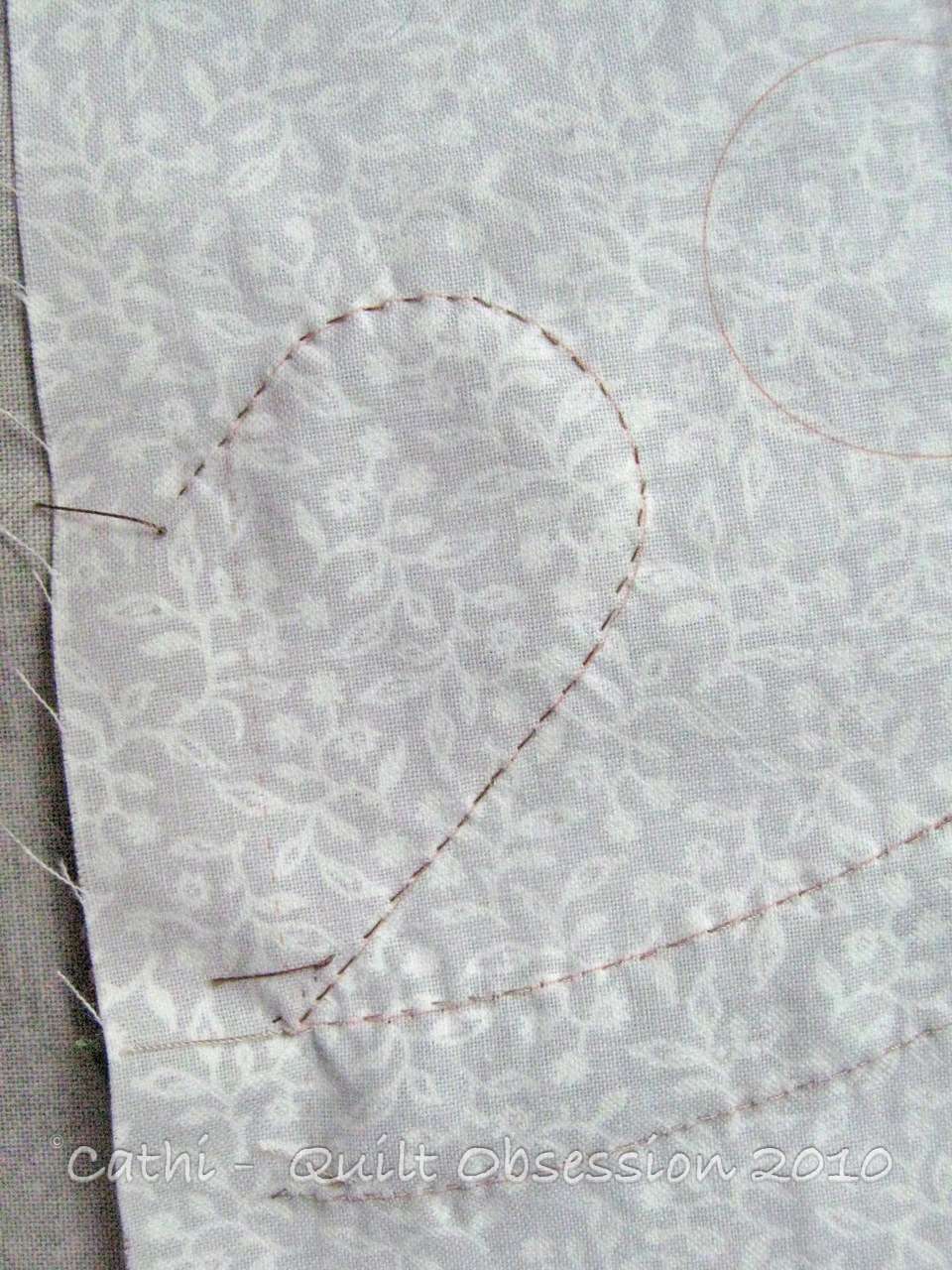
In this picture you can see how closely my applique stitches are right on the line of the design.  It also shows the lines of another shape, which I chose not to add to this part of my applique block.

Again, another picture showing how closely the applique stitches follow the line of the design.

Everyone has their favourite method, but I hope this little tutorial gives you the information you need if you’d like to try the back-basting method.

Smudge is hoping you found this relaxing and informative.