Hexagons, Hexagons and More Hexagons!

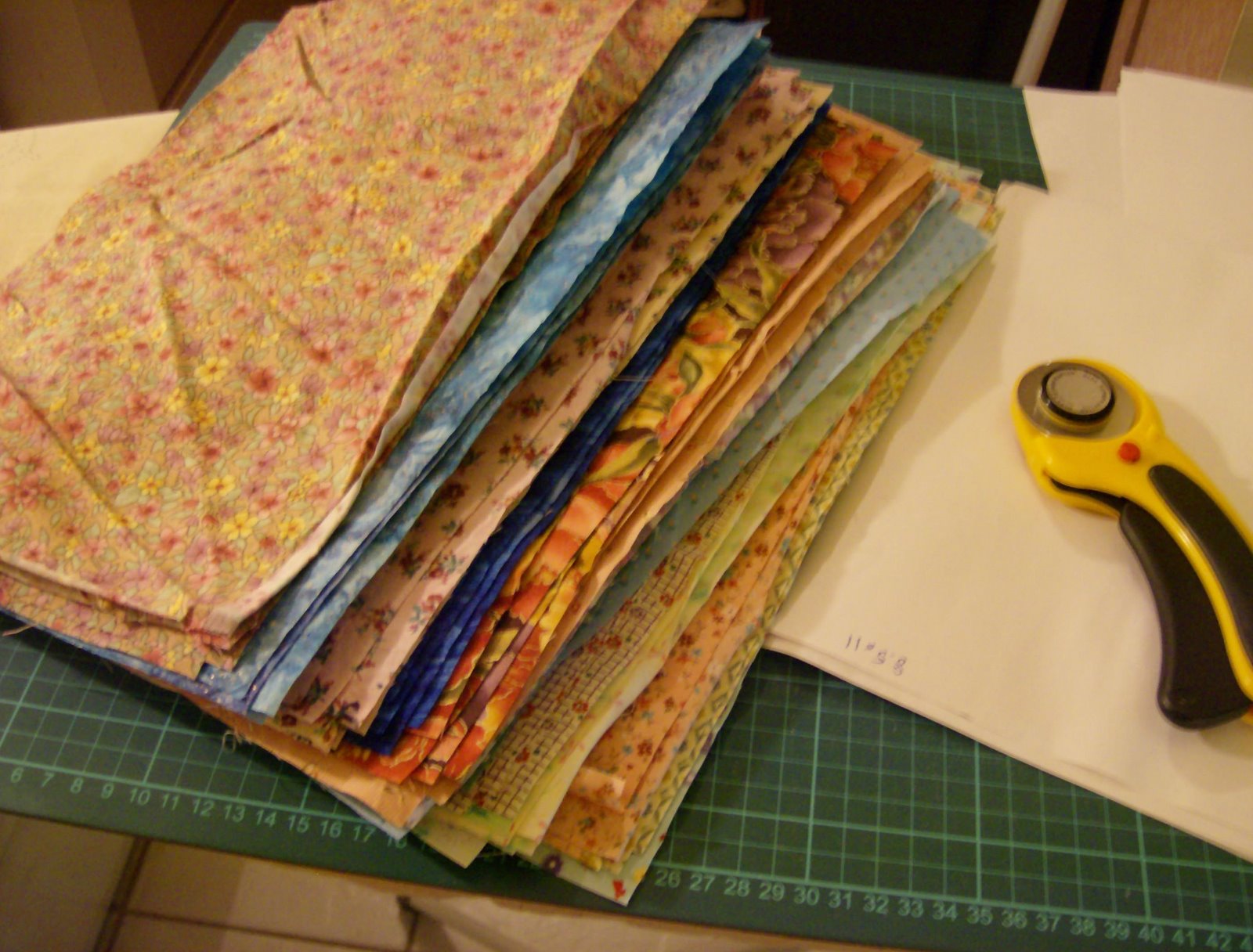
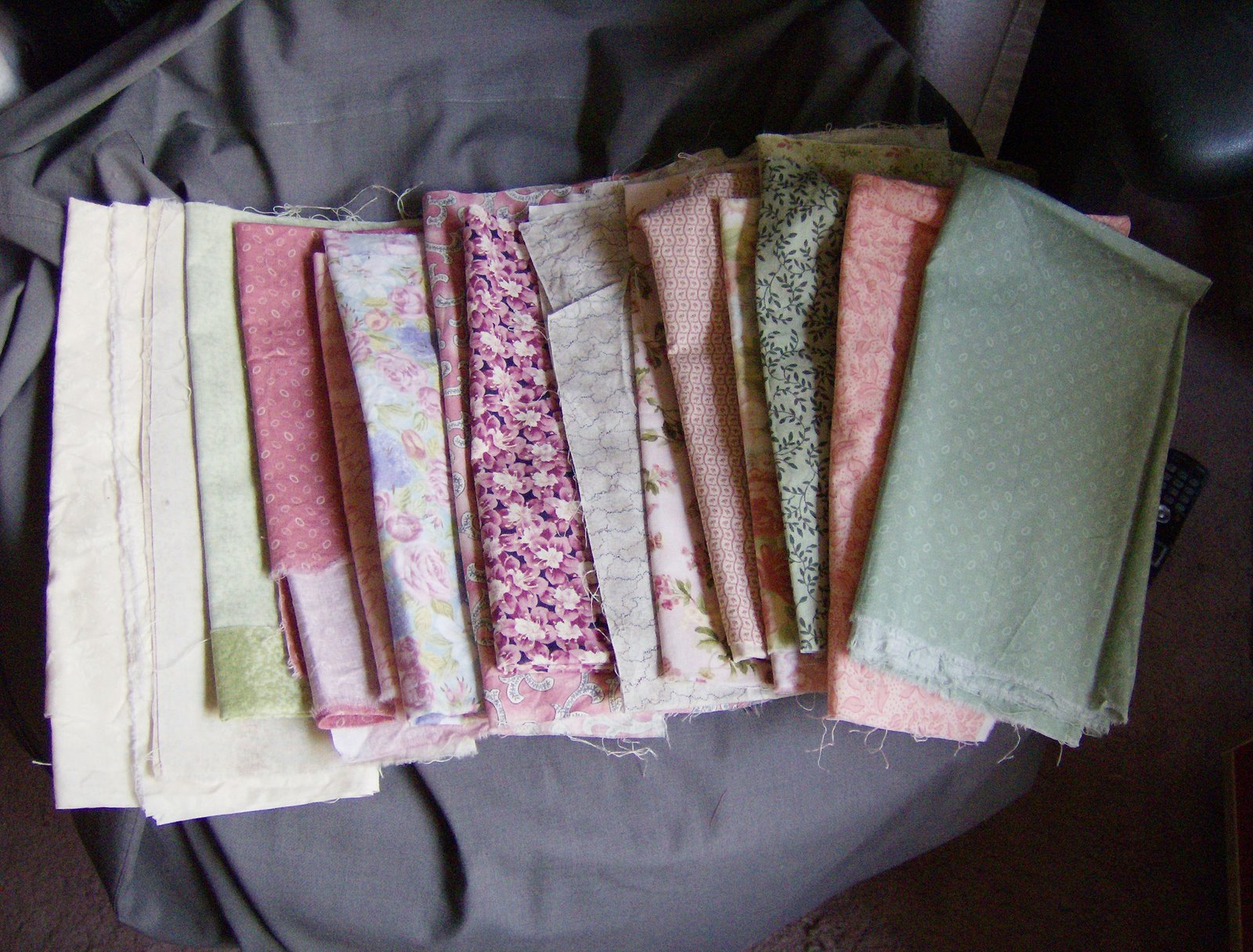
What did I do this weekend? Cut sheets of fabric — about 90 sheets of fabric in all.

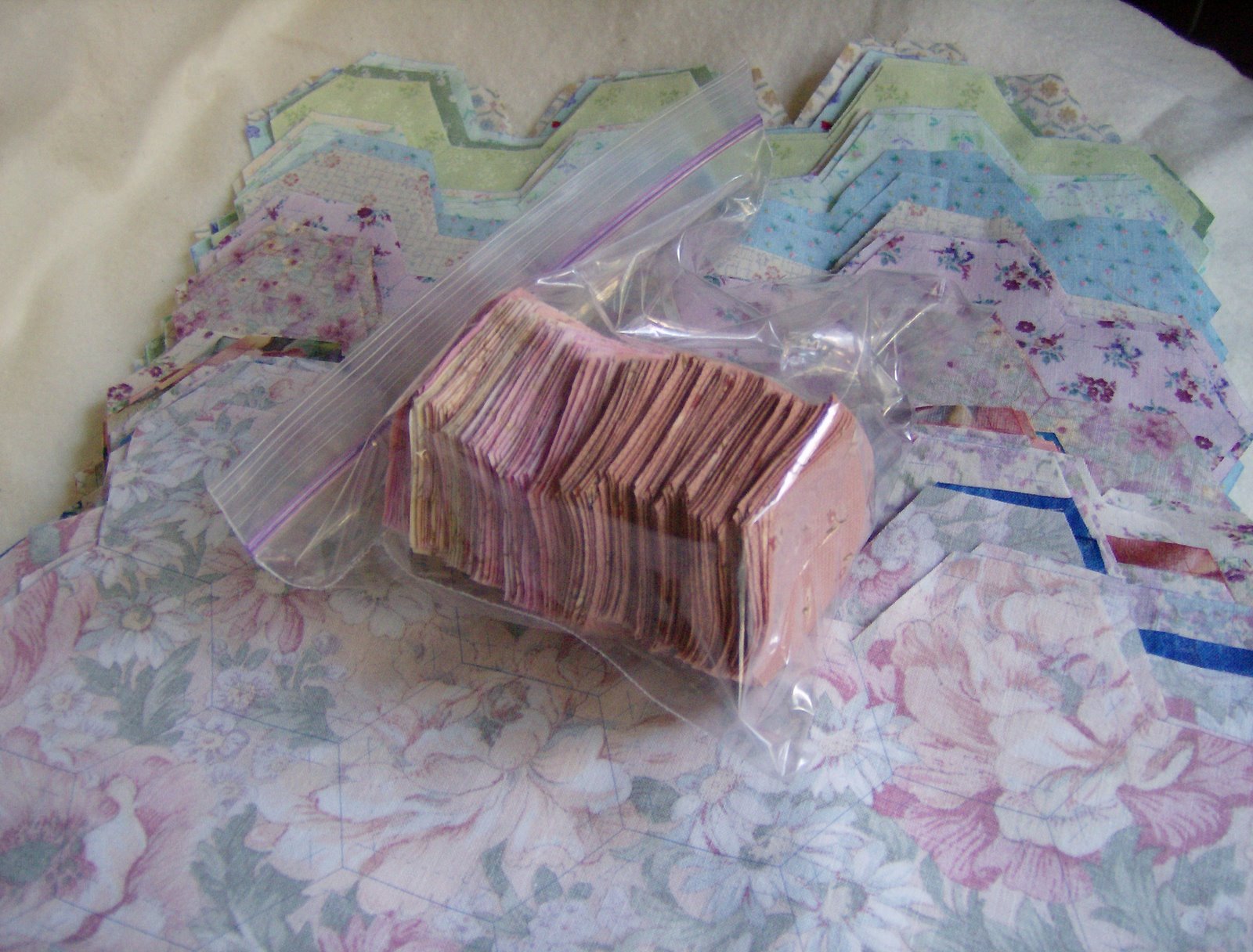
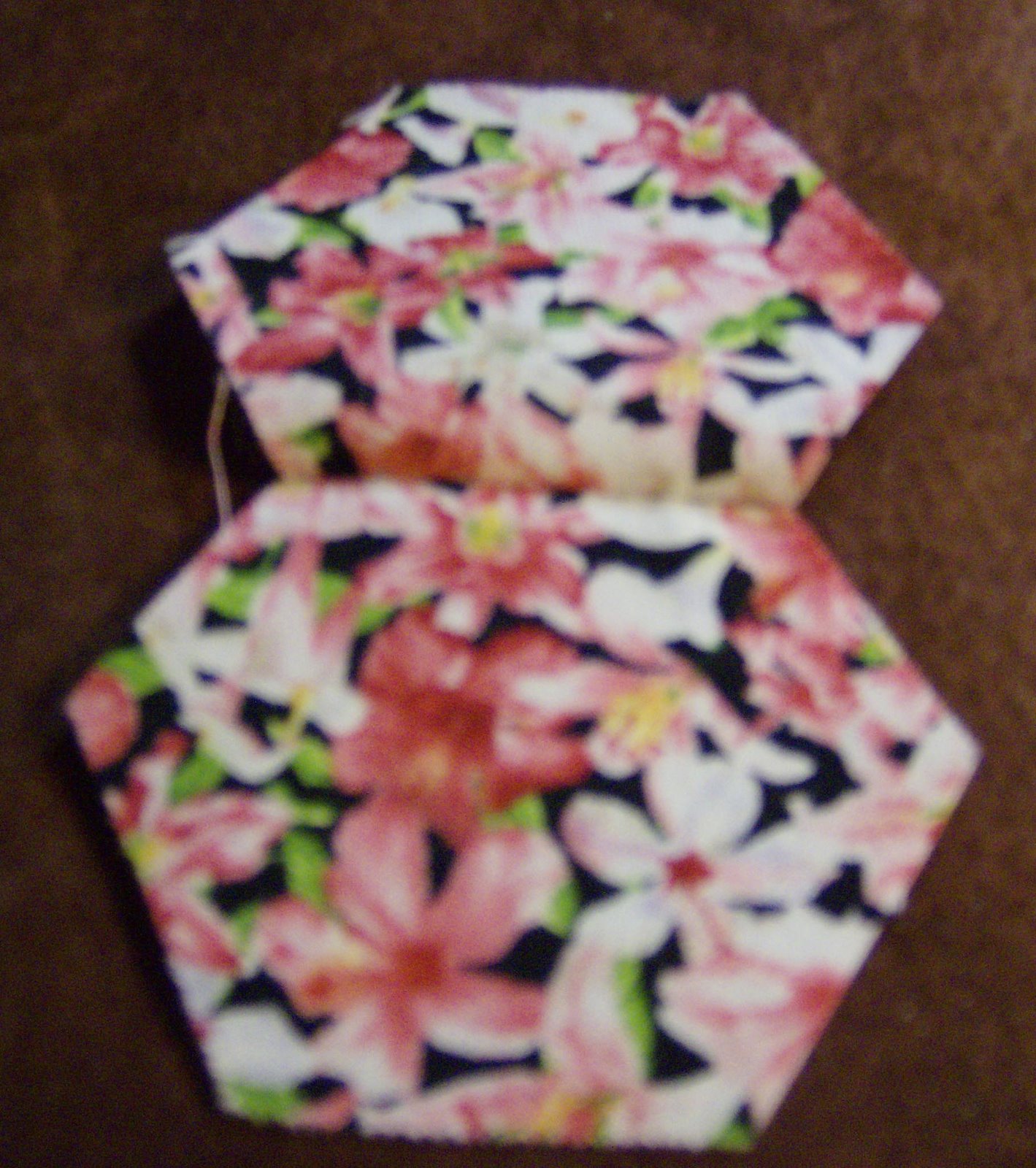
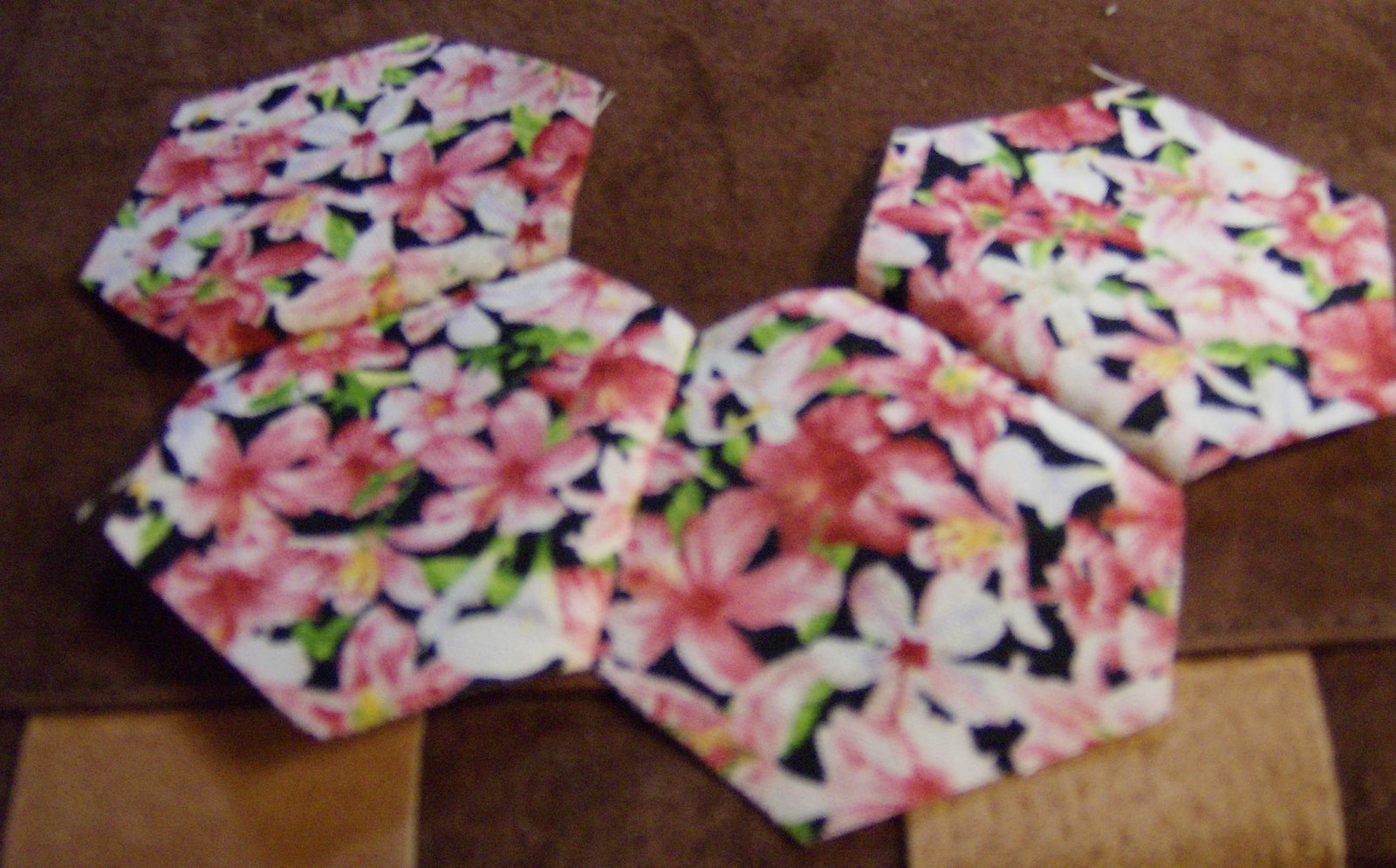
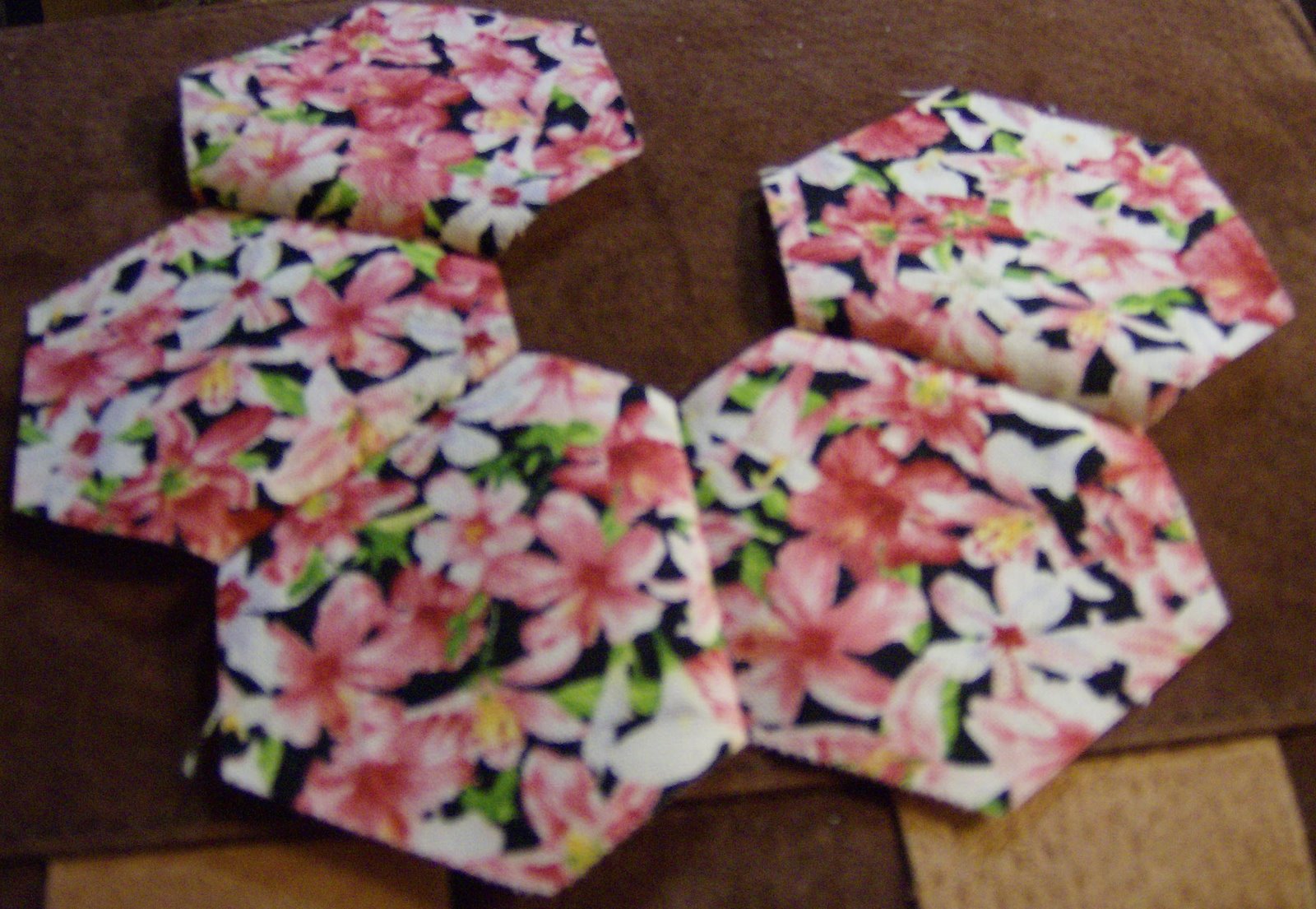
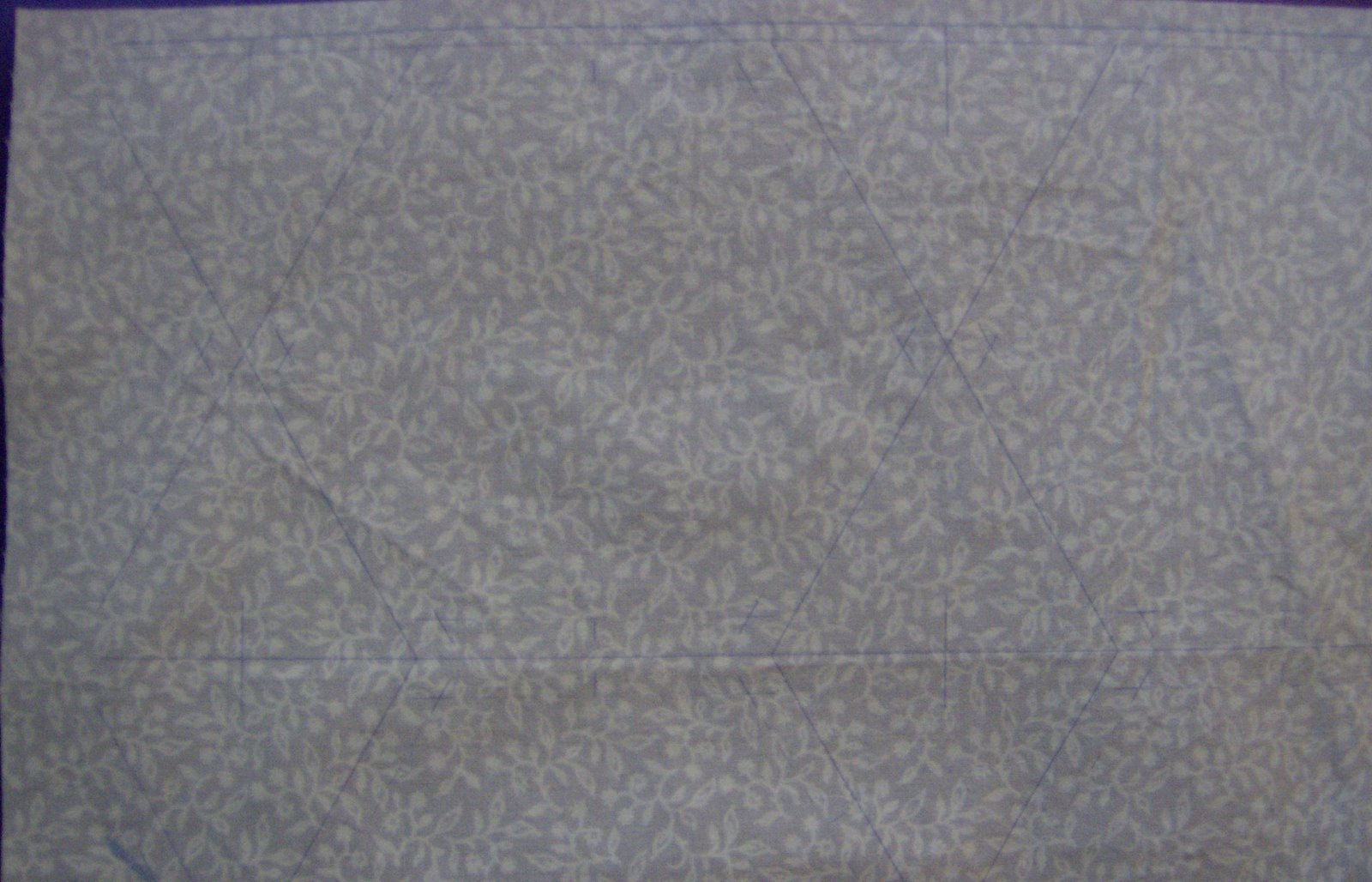
Then printed hexagons on the back of them all and started cutting them out. We’re having a swap of hexagons on the Inklingo list and I needed to print approximately 1,200 hexagons. I’ve started cutting them out — what you can see cut out in the bag are hexagons from 2 of the 20 fabrics I’m using for the swap.

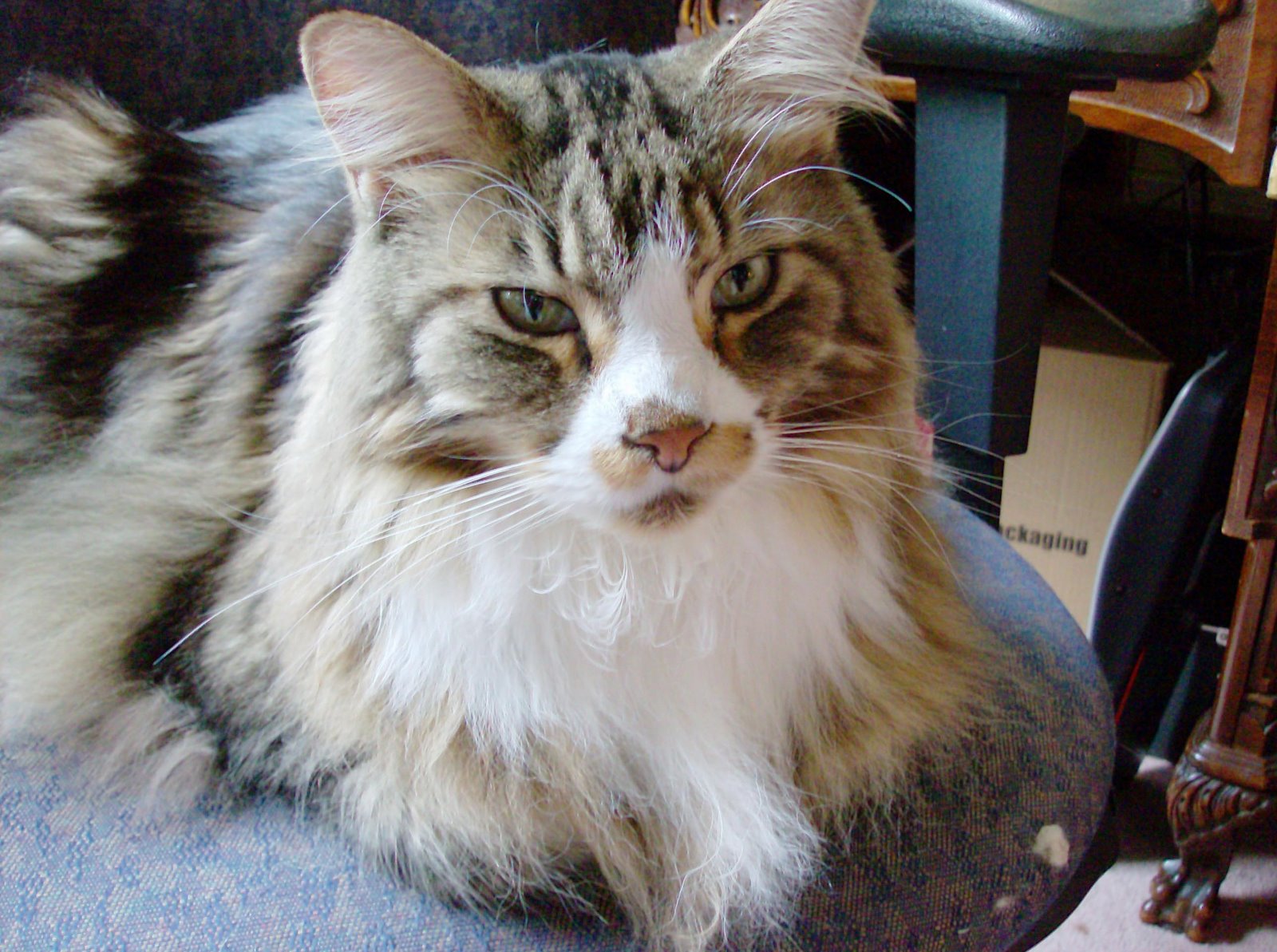
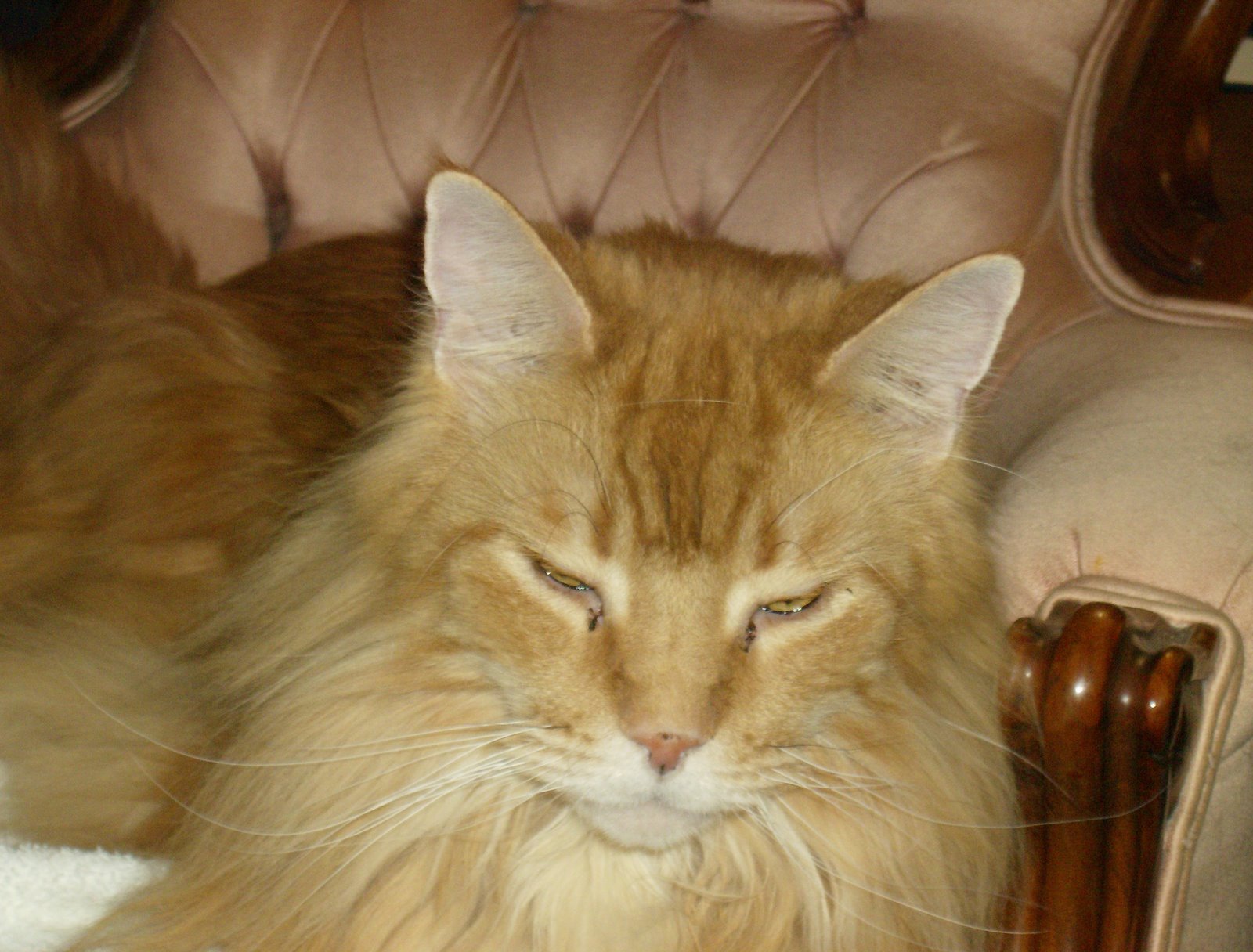
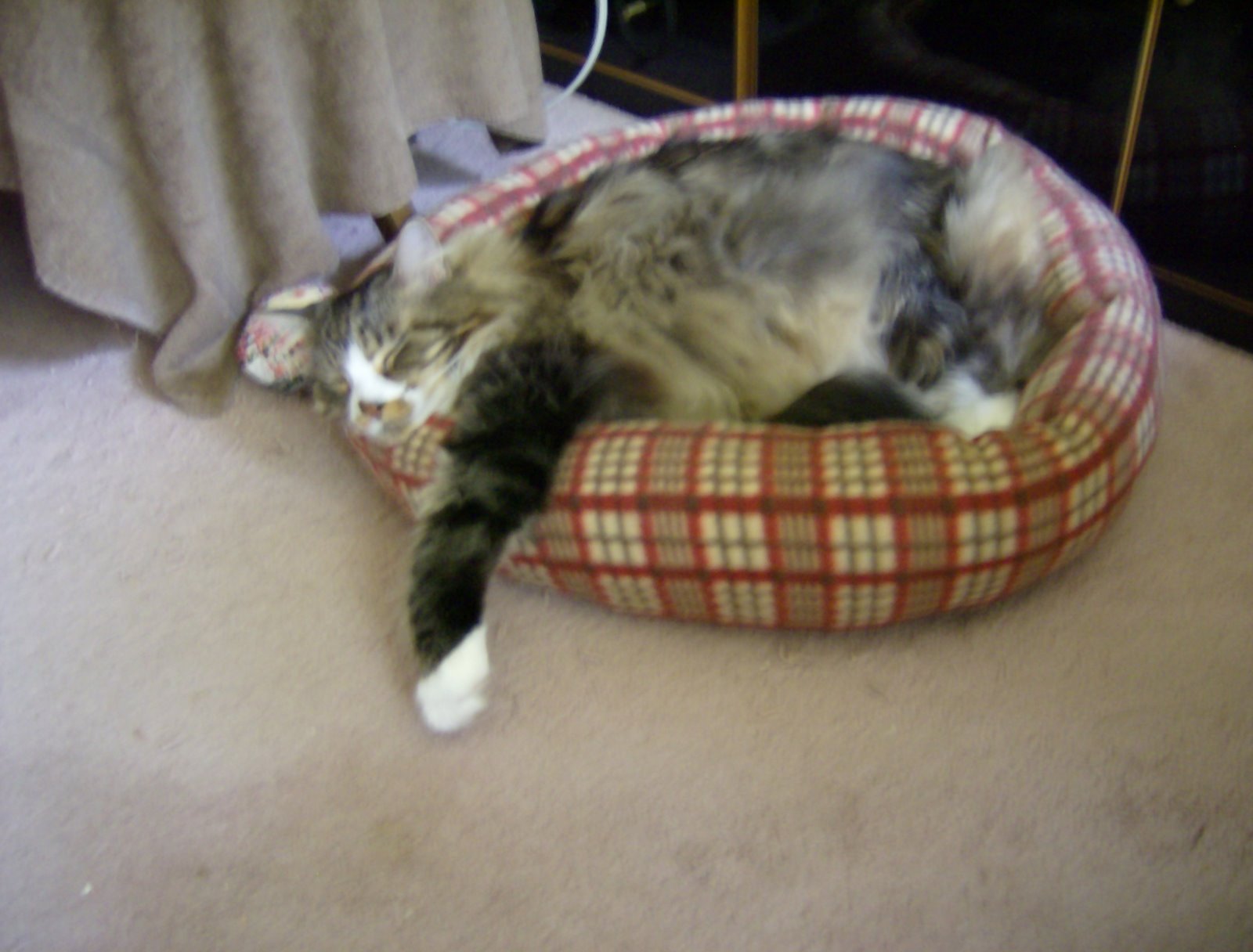
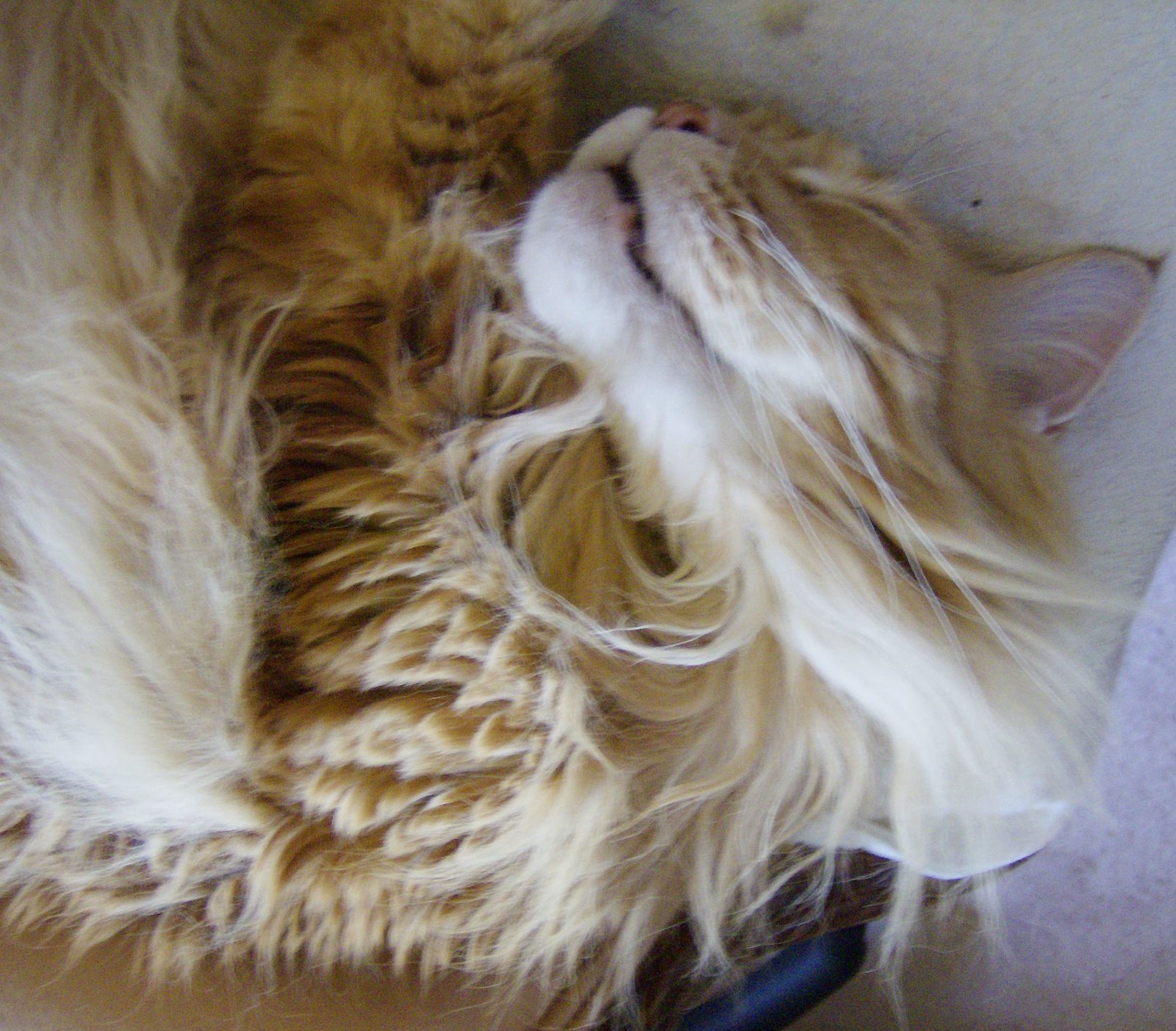
Smudge being — well, Smudge. I think he was either waking up or about to have a nap.


Stitching Hexagon Flowers

Warning — lots of photos in this one so may be slow to load.

I’ve been asked a couple of times about the stitching process for hexagon flowers the Inklingo way so thought this little pictorial tutorial might be a better route to go than trying to describe it in words. The method is one I learned from Linda Franz. Both her Quilted Diamonds books and the Inklingo product have wonderful instructions that make this and other methods incredibly easy to learn.

Edited to Add: All the hexagons for this project were printed using Inklingo , which prints very fine cutting and stitching lines as well as matching points in your choice of many colours on the back of your fabric. One always gets perfect precision when stitching as a result.

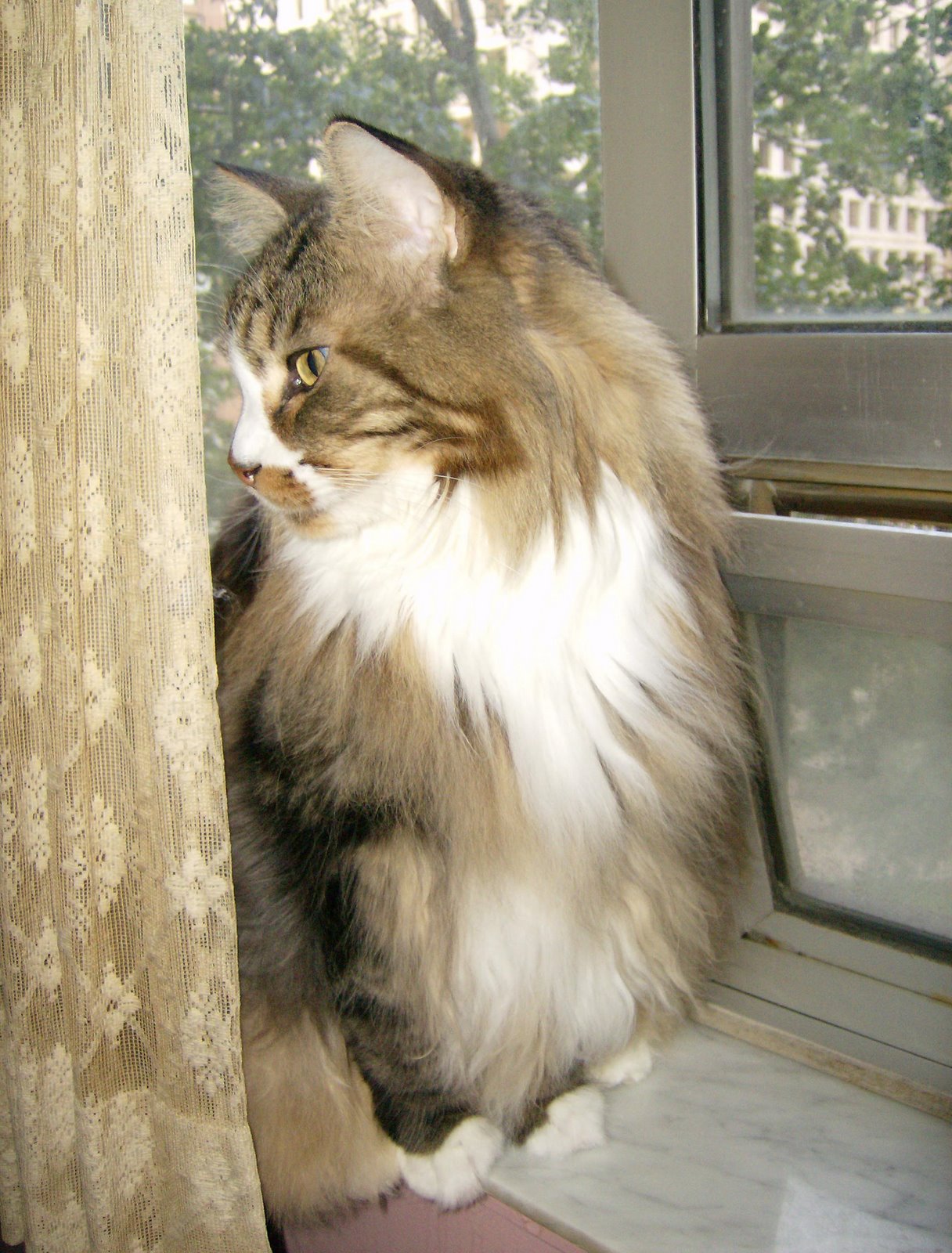
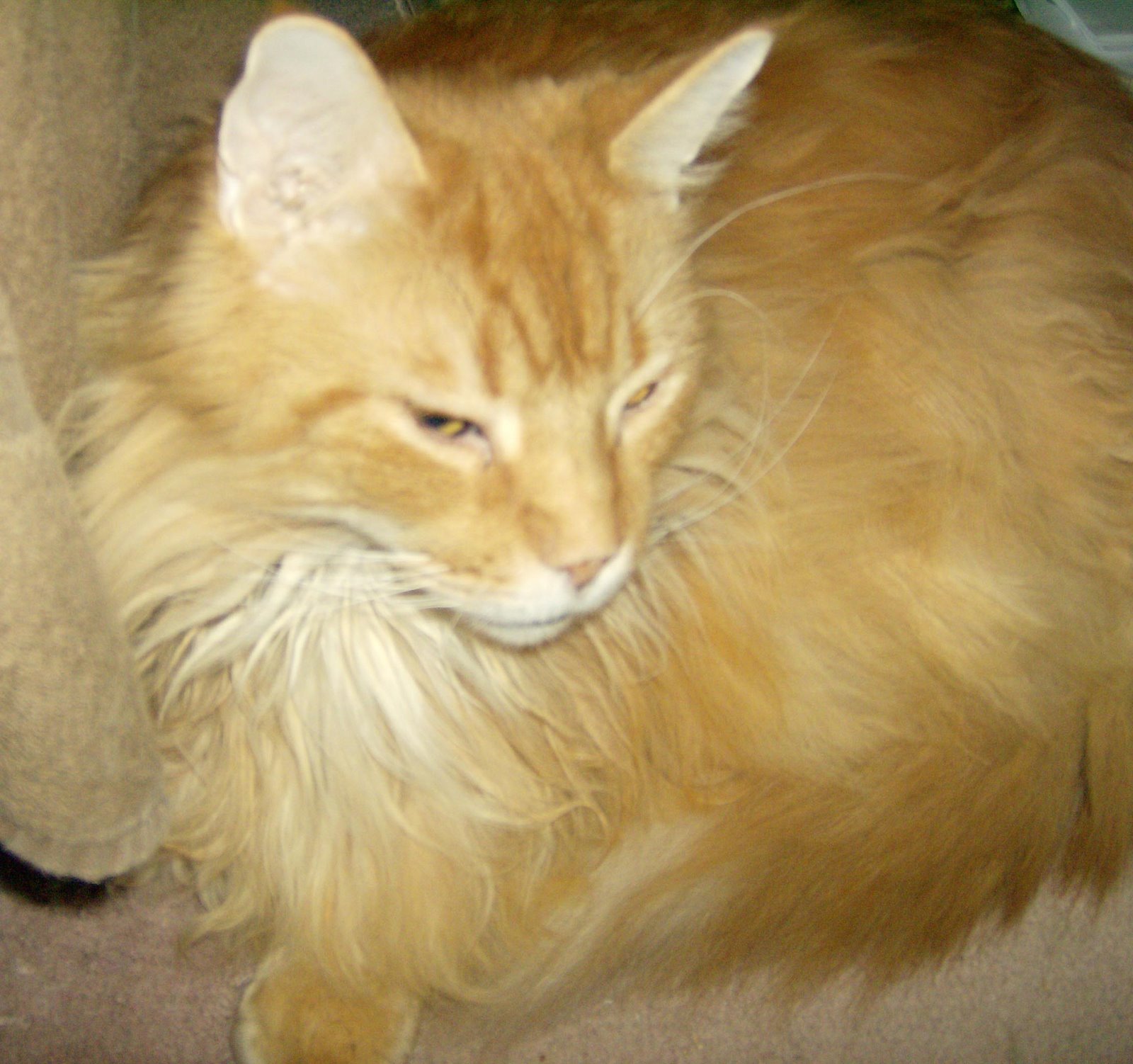
Lester’s peaceful countenance should help put you in the mood for some calming hand piecing.


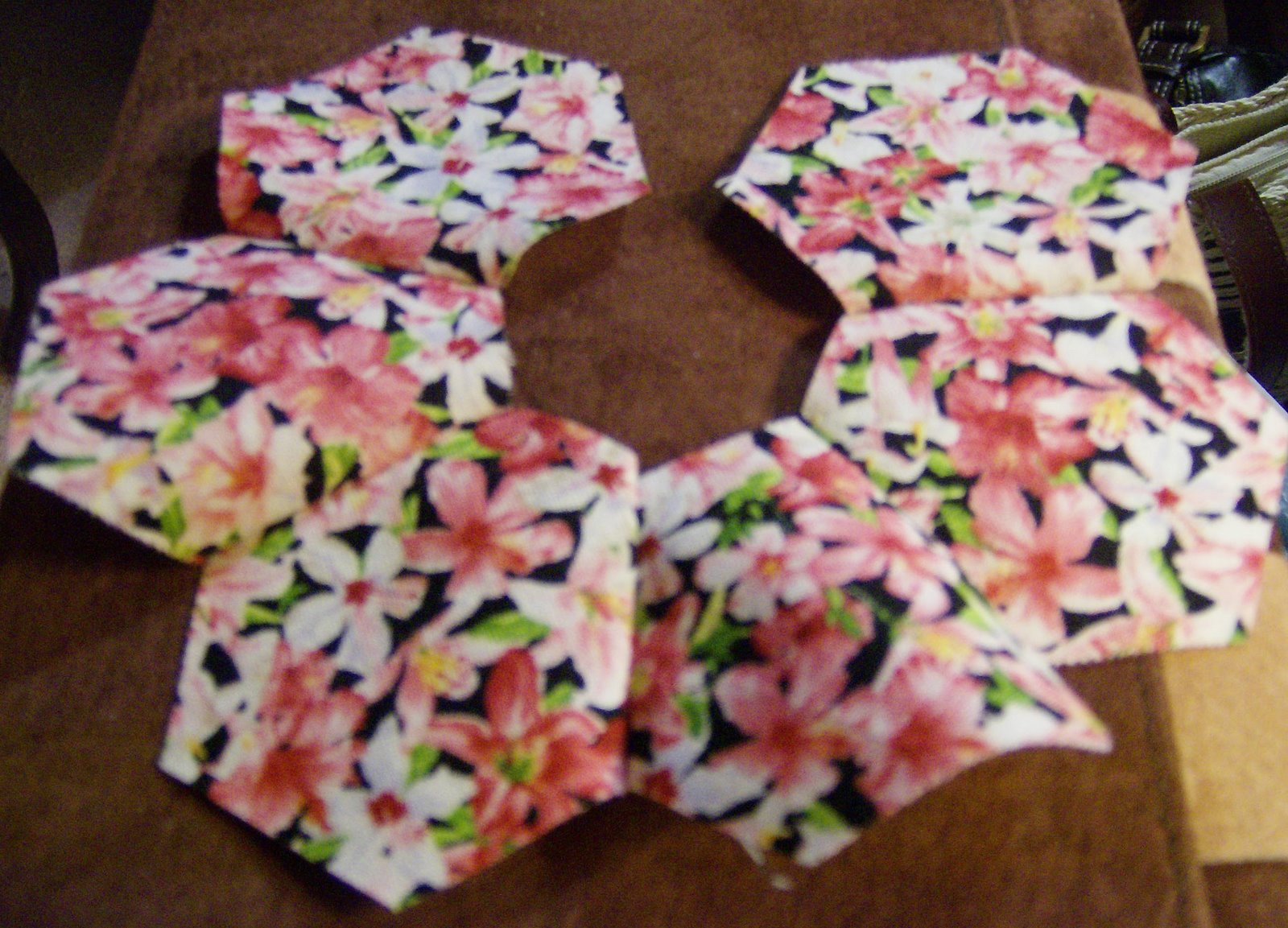
This flower will be made with 6 one-inch hexagons of one fabric and 1 one-inch hexagon of a different fabric in the centre.

Materials needed:  six hexagons for outer circle of 6, one hexagon for centre, needles and fine thread.

I use #12 sharps as both needles and as a pin as they are so fine. My “pin” goes right in at the cross-hair at the end of the little seam. I use YLI Heirloom, YLI Select, DMC or Mettler 60/2 threads for hand piecing and do try to match my thread colours as much as possible to the fabrics I’m using.

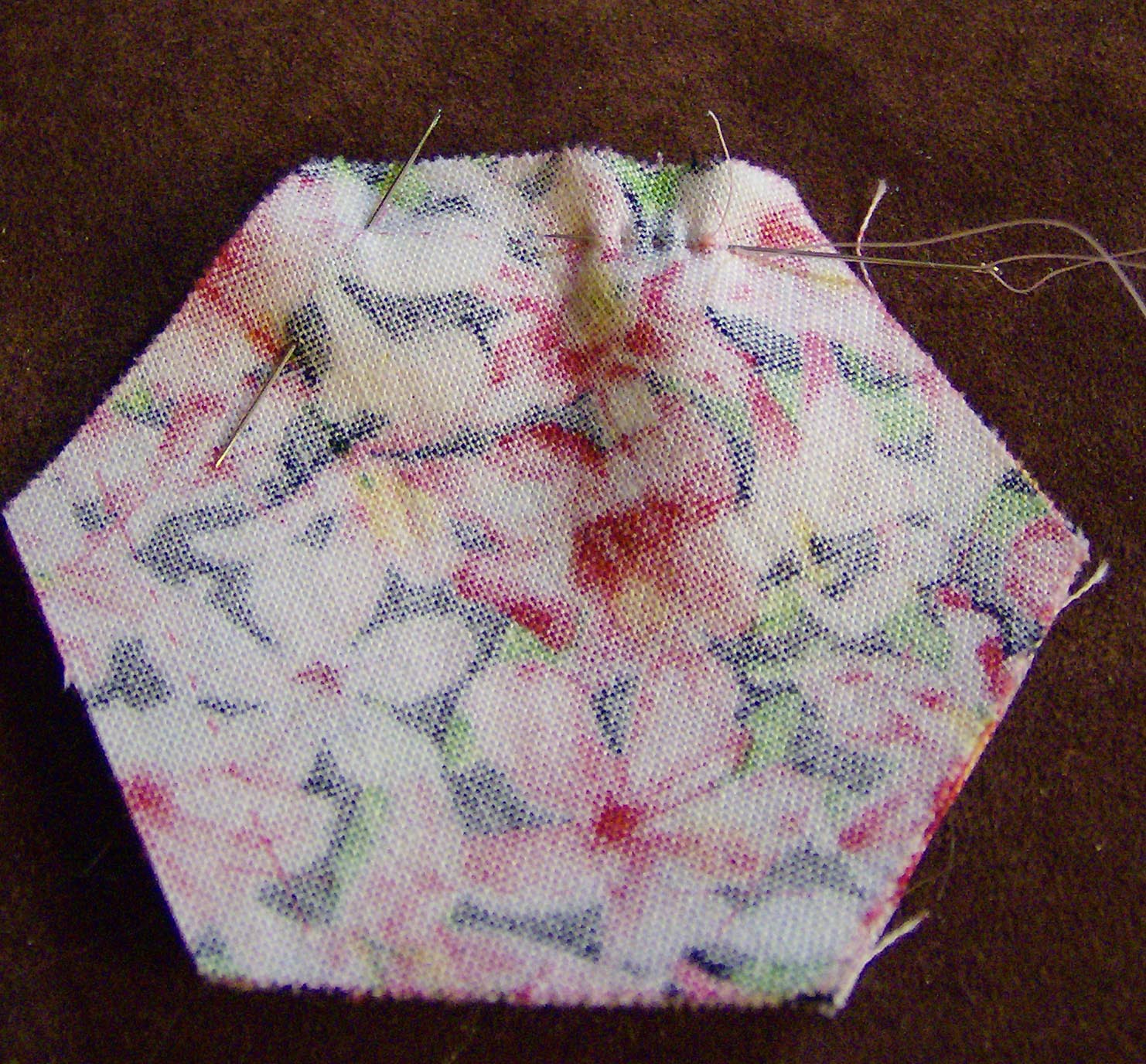
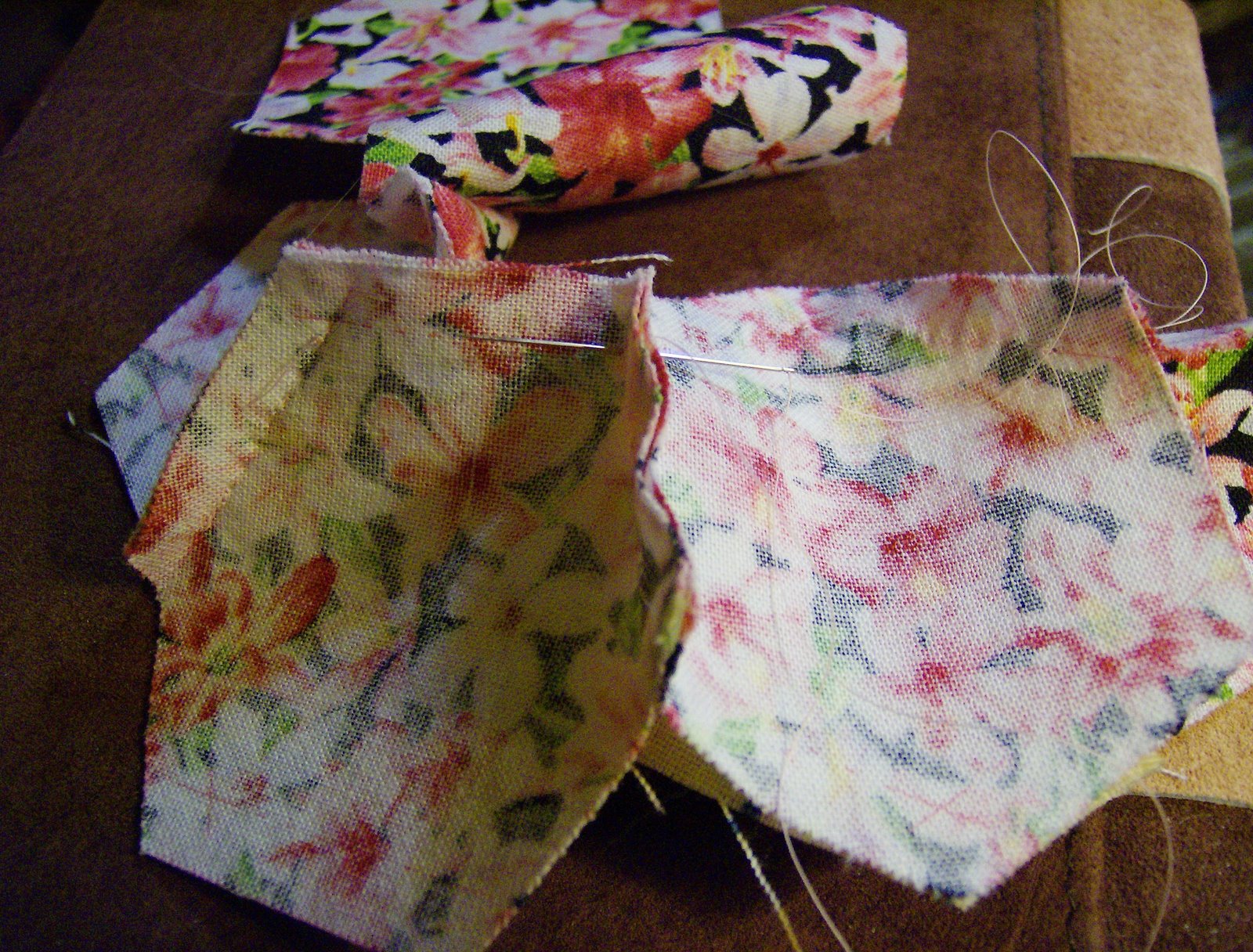
Here I have the first two hexagons of the outer 6 pinned together.


Then I start my seam. I make a quilter’s knot and then use this little trick I have found which helps make it easier when I get to the continuous stitching to attach the centre later. I insert my needle from the front, just a tiny bit over from the cross-hair on the right (I am right-handed) and
come back up from the back right in the cross-hair. Then I immediately take one very tiny stitch, which serves as a back stitch and then a load of 4 or 5 running stitches on the needle. Pull the needle through, take another little back stitch and load up the needle again.
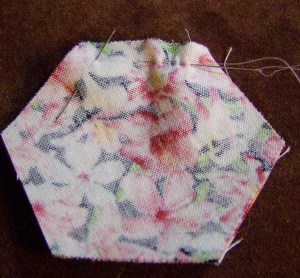

Now I’m at the end of the first little seam. Finish the seam right at the cross-hair and then take another back stitch, turn the piece over and take another back stitch through the opposite side and make my quilter’s knot to tie off. This way I have no knots right at the intersections, which I have found does help later on.
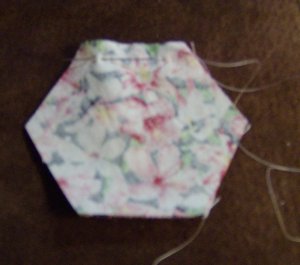

Because I was using very fine YLI Heirloom in a pale pink for this flower, it is almost impossible to see the stitches on the fabric. Just to give you an idea, here is a shot of the blue and white fabrics of the Texas Star quilt — I stitched that with DMC blue thread which you can see on the white hexagon in this photo.


Here are the first two hexagons stitched together.
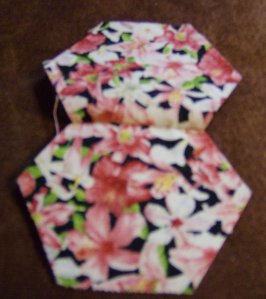

Now attach the third hexagon in the very same way, stitching from cross-hair to cross-hair.


Half the outer circle of 6 hexagons is now complete.


Now 4 are stitched together.


Now 5.
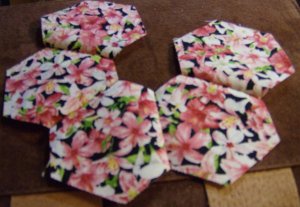


Finally, the 6 hexagons of the outer circle are stitched together all but for the final joining seam, which gets stitched after these are stitched to the centre hexagon.


Now it’s time to start joining the outer circle to the centre hexagon. I pin the first of the outer circle hexagons to the centre one right at the cross-hair and start another little running stitch seam, again with a back stitch.
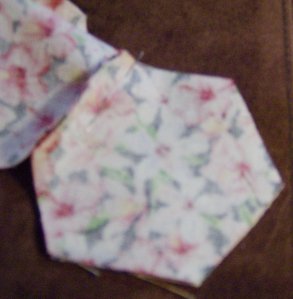

When I get to the end of that first little seam I take a little back stitch and, rather than knotting and cutting my thread, I just continue on by inserting my needle right through the cross-hair of the seam and then starting to stitch the second hexagon of the outer circle to the centre hexagon. I continue that way right to the end, never having to break the thread. Continuous stitching like this makes putting a hexagon flower together very quick. This is the reason I like to try to avoid having my quilter’s knot right at the cross-hair — it makes it easier to get my needle through the seam and start the next seam.
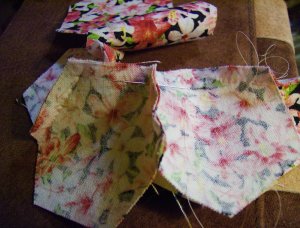

At this point, I have half of the outer circle of 6 attached to my centre hexagon.


I have now finished joining all 6 of the outer hexagons to the outer circle and all that is left to stitch is the final seam between the first and sixth of the outer hexagons. Once again, I pin through the cross-hair and stitch right to the end.
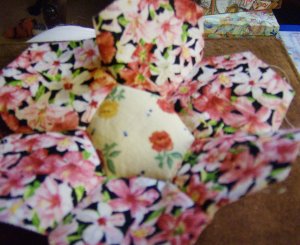

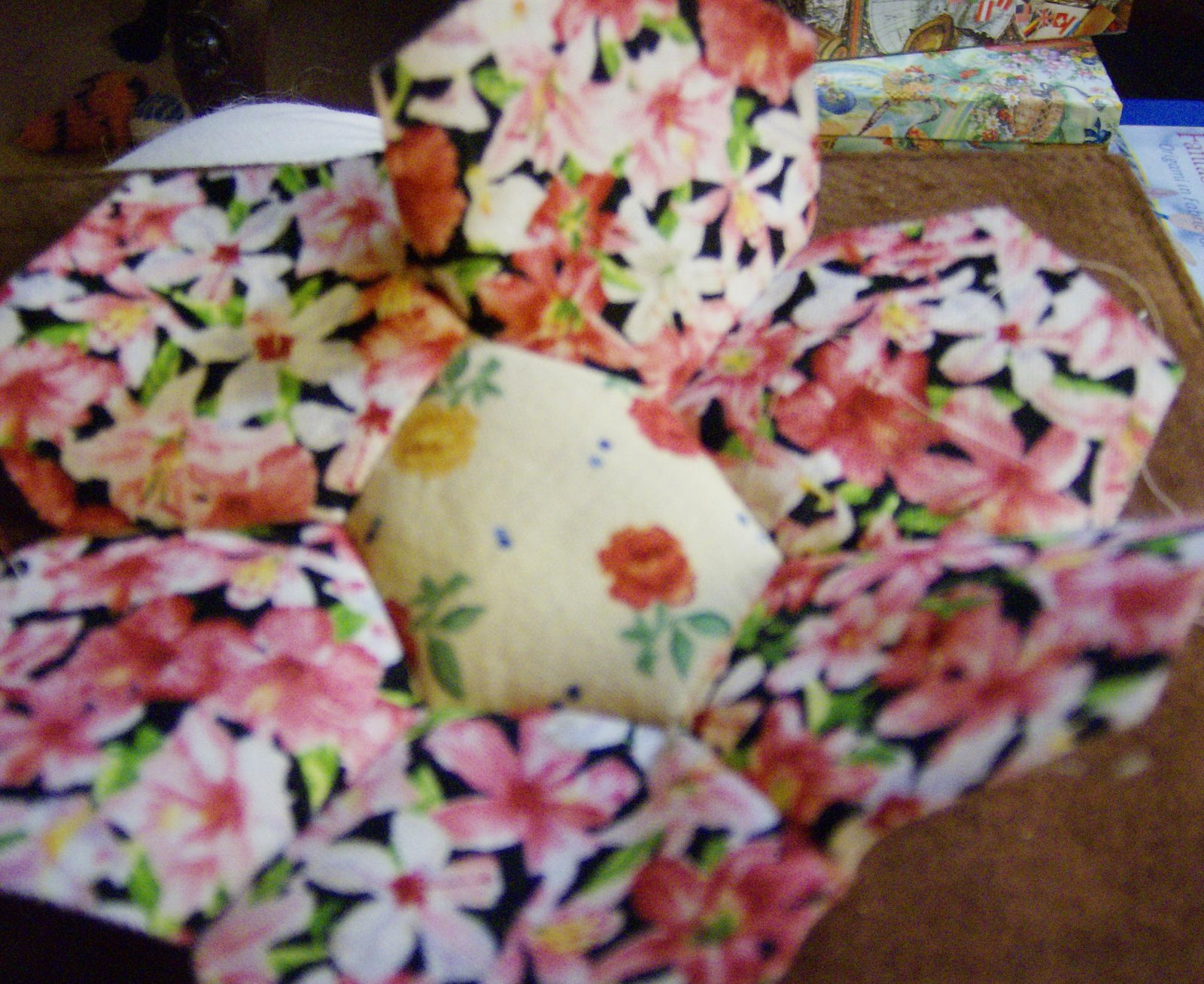
A completed hexagon flower all done with a running stitch. Simple as can be. No cutting out or buying commercial papers or basting or whip stitching. Just a nice simple running stitch and lots of wonderful continuous stitching.
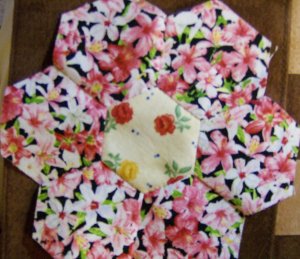

This is the back of my little hexagon flower, ready for pressing.


Because I was stitching this late at night and because hand stitching means one can leave pressing to another time, I have these two photos of hexagon flowers made using .75-inch hexagons that have been pressed. You can see how the seams are pressed to distribute the bulk.


Making GFG flowers this way is so quick and easy and incredibly addictive!


Now, Lester wants to know — was this a calming experience?

Swaps and More Swaps!

I must have swapping fever! I’ve joined this:


I remember reading posts on various blogs last year around Christmas and the 2007 SSCS seemed to be a resounding success, so I definitely wanted to join in this year.

On top of that, I’ve joined this:

I saw some of the quilts from the last round of this swap on various blogs and was wishing I had joined in. So now I have.

Betsy at Quilting Fiesta, my Four Seasons partner for the summer quilt, e-mailed today saying she had received the orchids quilt. I was relieved as I’m always just a bit nervous when sending things like a little quilt in the mail.

And, if all this isn’t enough, we’re having another centralized swap on the Inklingo list which I’m hostessing. This time we’re swapping strips of 7 one-inch hexagons. These swaps are great as it gives one a chance to amass enough pieces for a charm quilt or, as in this case, enough hexagons to make a fair number of hexagon flowers — certainly enough for a small quilt.

I don’t think either Smudge or Lester are particularly impressed by all this swap mania!


One More Finish for July

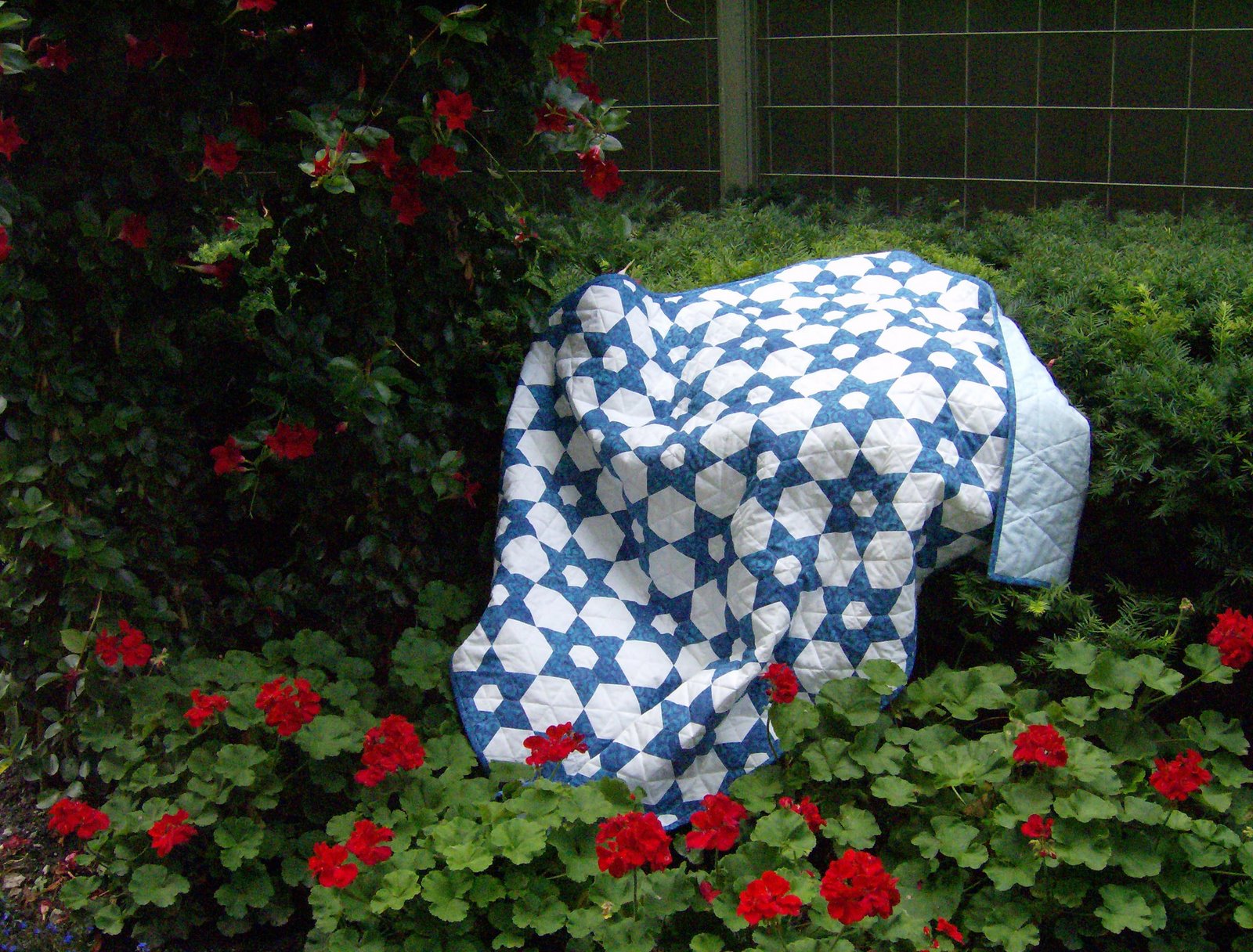
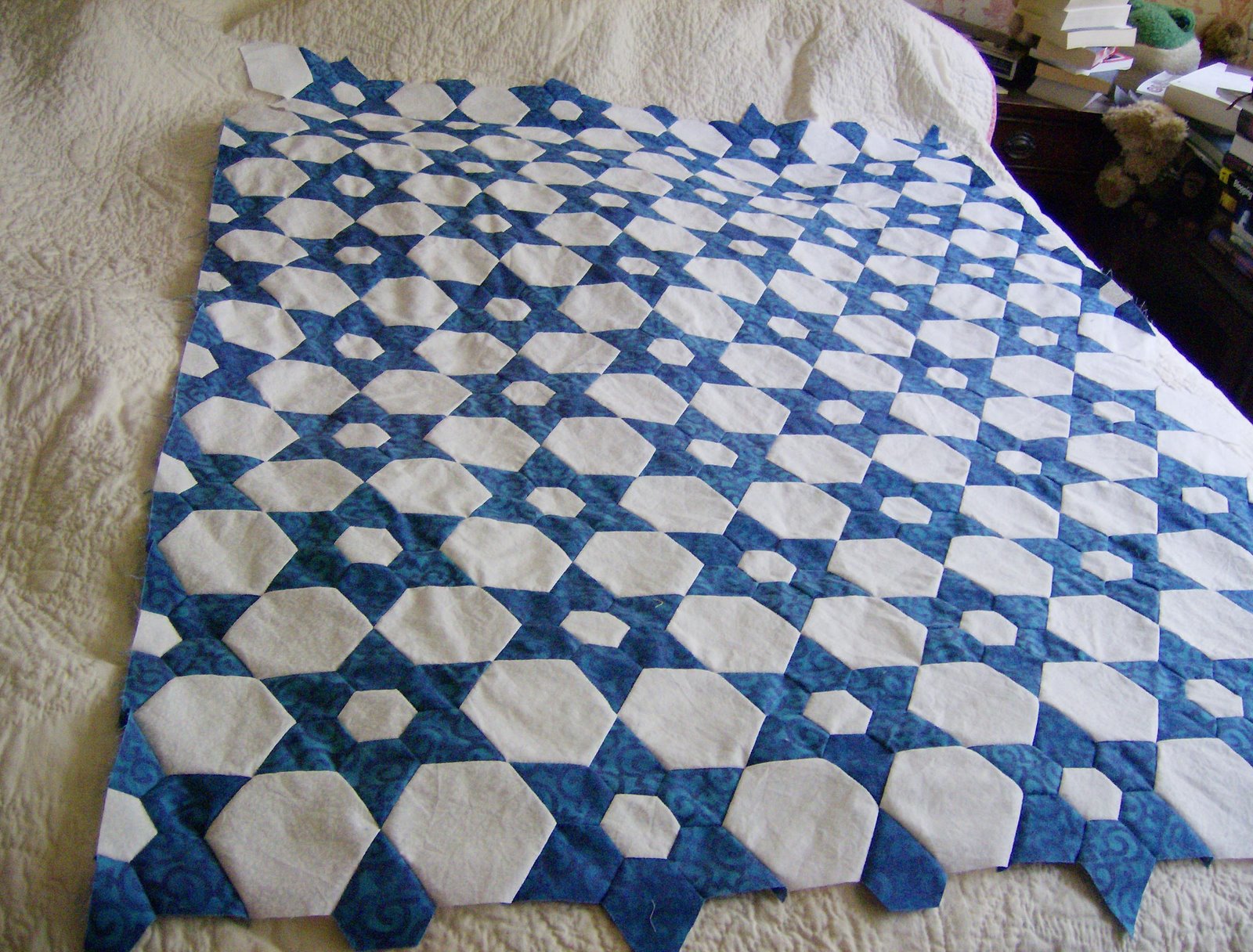
Thanks to Peg’s challenge, I finished this blue and white Texas Star quilt. The last of the binding was tacked down late last night. I am thrilled to have it finished and know that if it hadn’t been for Peg’s challenge, it likely would still be sitting in bits and pieces. I kept avoiding it because the white on white fabric was so tough to needle but now it’s done and I’m ecstatic!

It was a very odd day here today. Raining and thundering, then sunny, then cloudy again — I don’t know if it’s over yet, but at least it stopped long enough that we could get a picture of the quilt out on the roof garden.

And yet another rainy day sleepy kitty picture of Smudge. 🙂


Another Pincushion

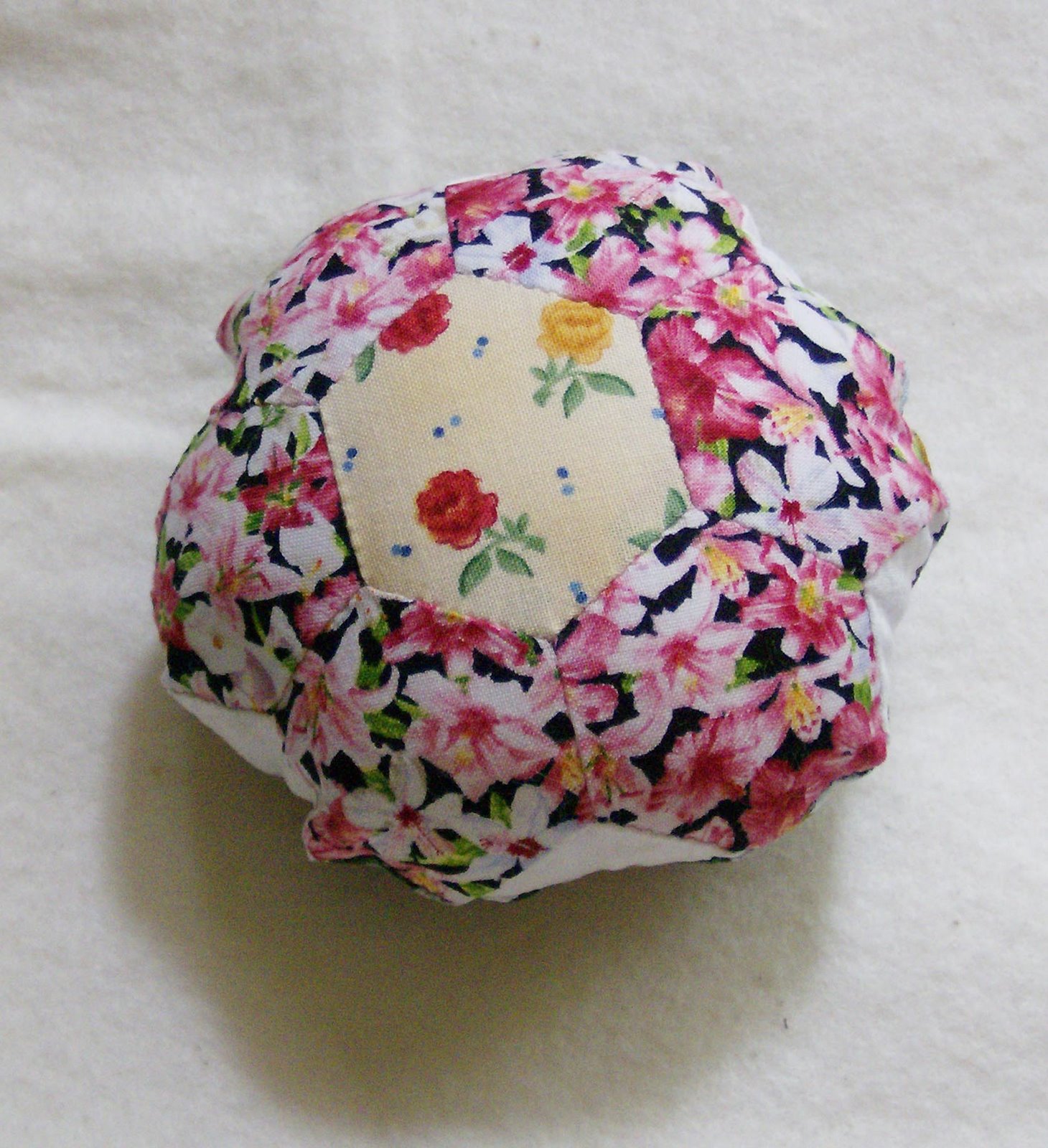
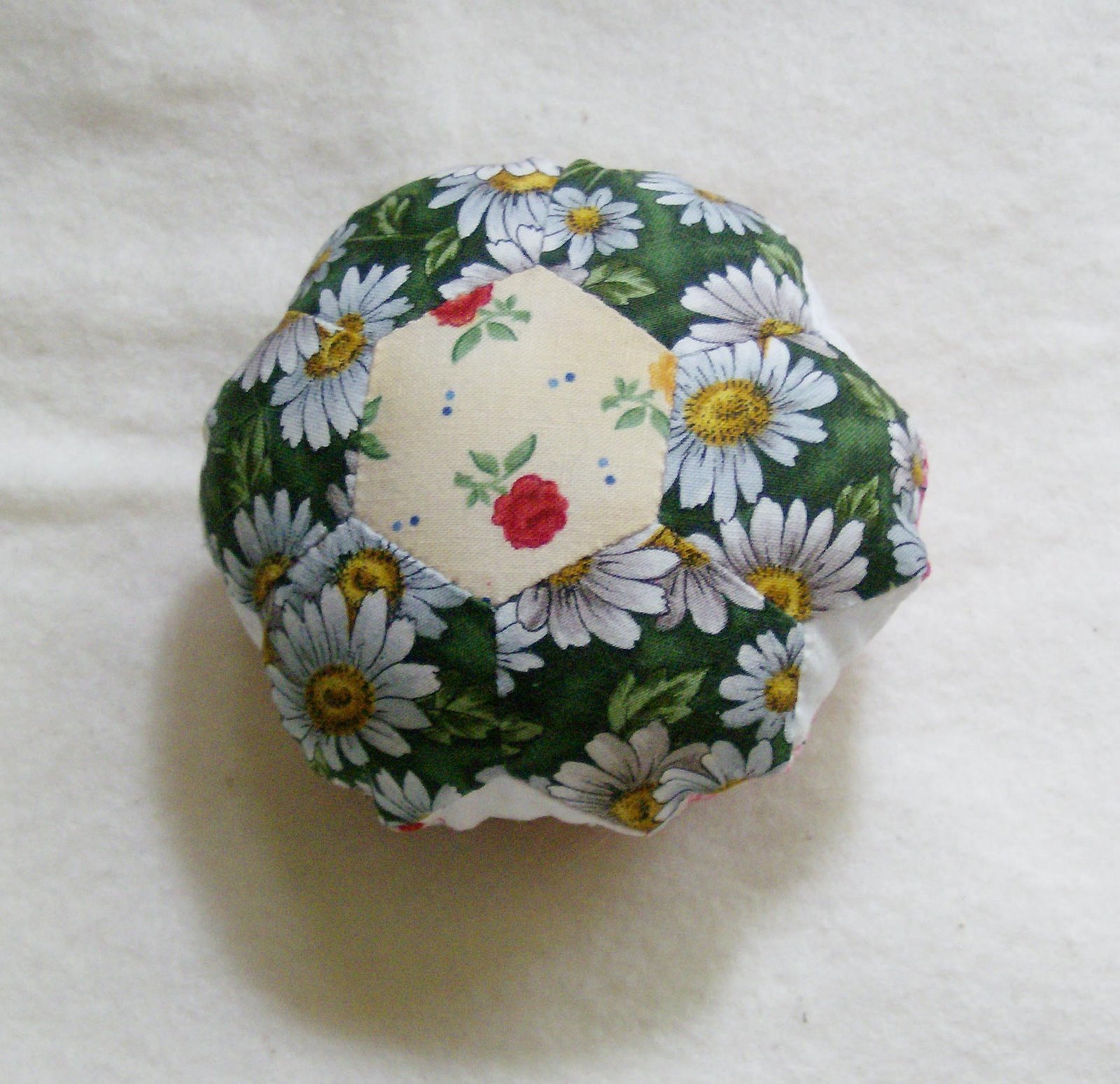
After making the starfish pincushion, I wondered what one would look like made with 2 grandmother’s flower garden blocks. So I grabbed 2 GFG blocks I had stitched together and six one-inch diamonds and made this pincushion.

This is the other side. It’s rather thick and not even my longest pins come through on the other side. Stuffing this one was much, much easier as I had found a bag of fibrefill (or whatever it’s called). Way easier to use than tearing off bits of cotton batts and stuffing those in!


I’m not quite sure what this look is, other than maybe a just waking up look!

The heat and humidity over the weekend were high. However, it has broken a bit now and is quite pleasant. We had absolutely torrential rain yesterday and a portion of the roof garden that is on an incline seems to have turned into a wee bit of a mud slide. One of the cleaning staff has been out on the roof garden for hours this morning trying to clean it up.

An Almost Finish

The blue and white stars are almost completed. I have a few pieces to add along the edges and in two corners and it will be done! I’m still debating whether to add a small border, although I love the look of quilts that just end with the binding.
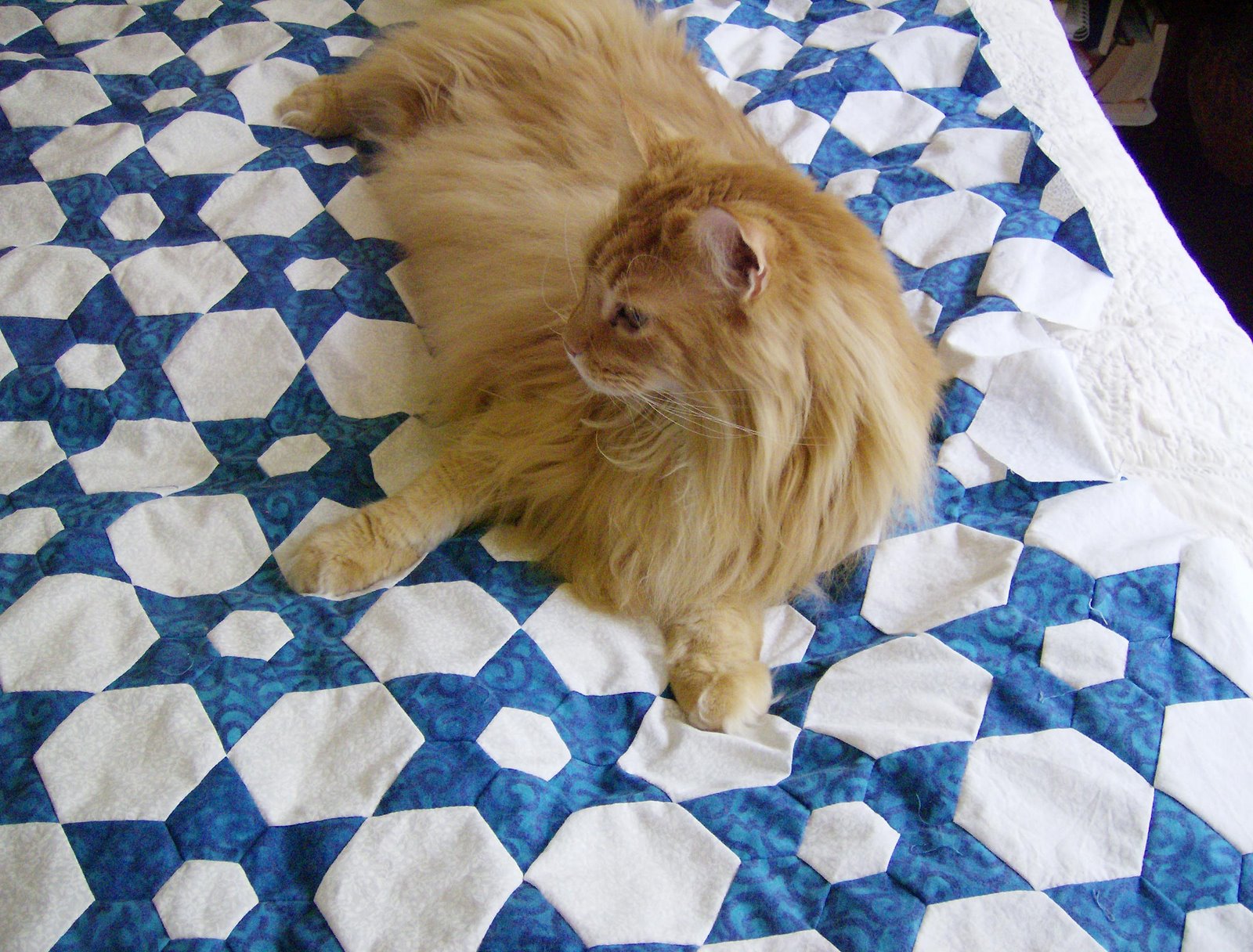
When it was spread out this morning to take pictures, Lester decided he needed to inspect. I think he’s given it the kitty paw’s up seal of approval. Just to give you an idea of the size of his paws, the white hexagons on which he has a paw are hexagons with 2″ sides. There’s a reason we call Lester our house lion!

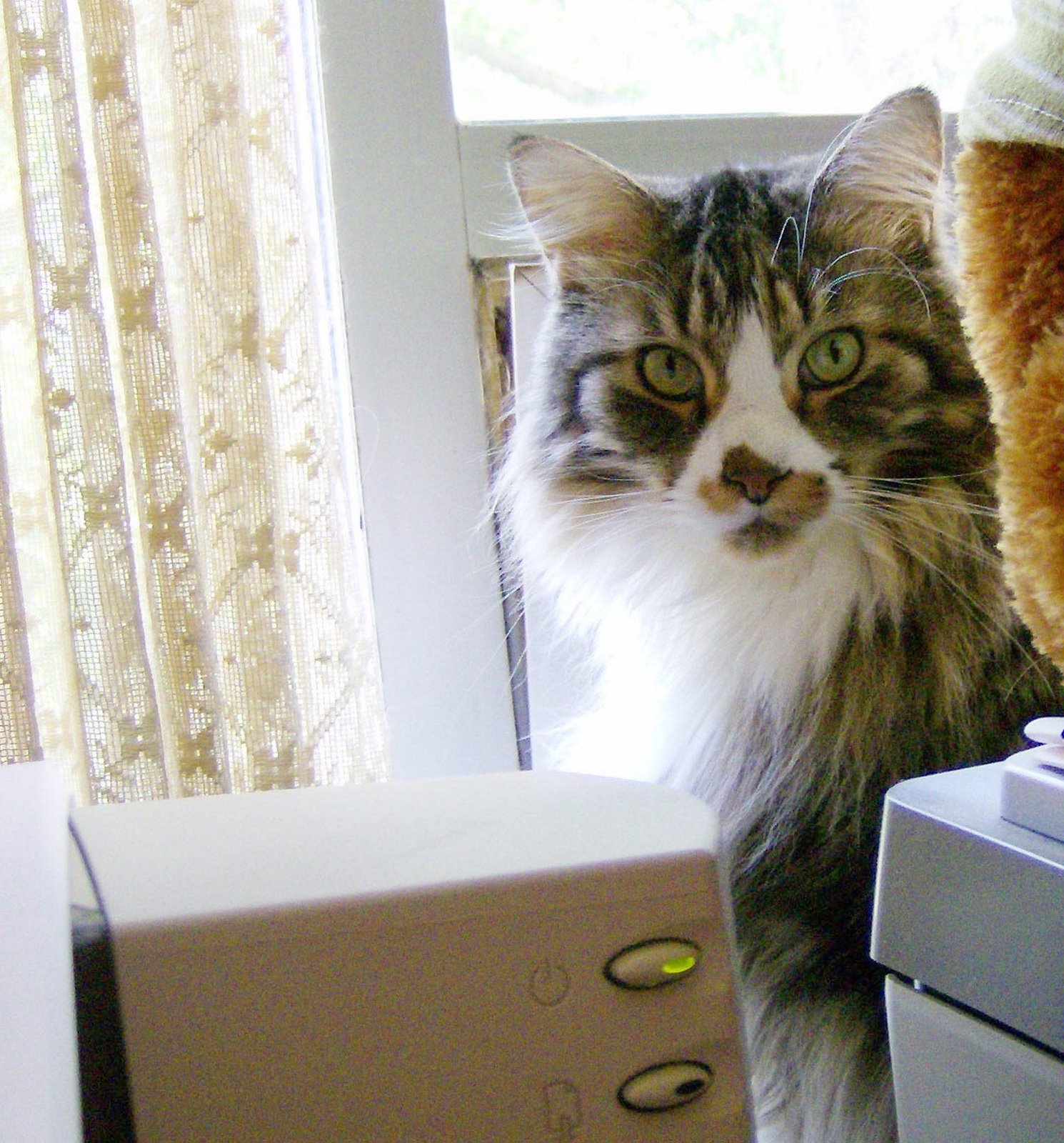
The other day when I was printing a few more of the star points, Smudge decided he had to come watch. It was so funny to see him peeking between printers.


Printing Shapes for Blue and White Star Quilt

I realized that I need more star points and 2″ white hexagons for the blue and white star quilt. So Saturday afternoon, after we got back from the LQS, I cut my fabric to size, ironed freezer paper on to the “right” side of the fabric and then started to print.

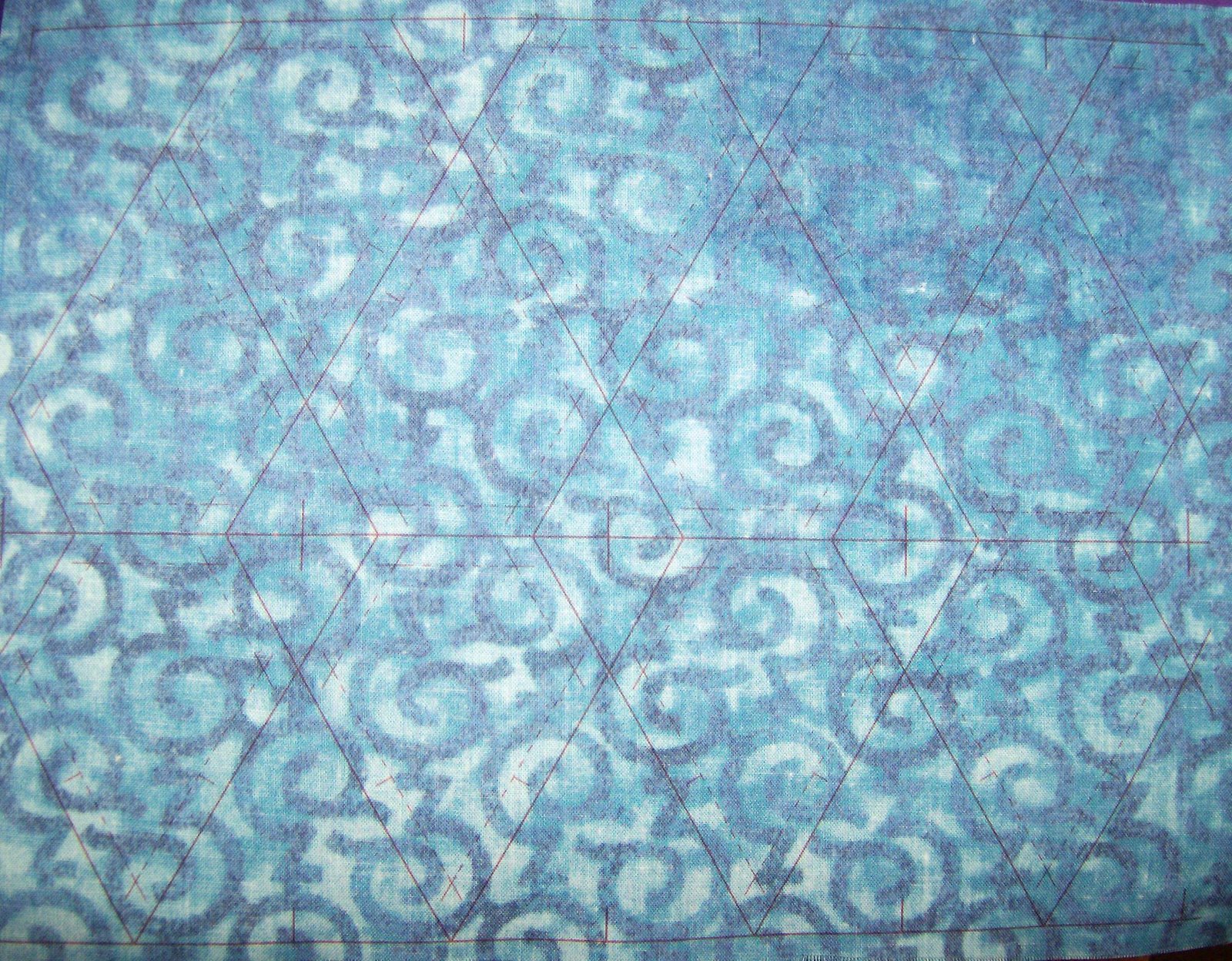
I’ve darkened these photographs so you can see the lines. The lines on the blue fabric I’m using for the star points look almost black. They’re not — they’re a red. I’ve tested my ink and know it washes out of fabric quite easily.

This one, I know, is rather tough to see. If you click on the photo to enlarge it, you will see the lines rather easily. The lines for the 2″ hexagons on the white fabric are a very faint blue that doesn’t shadow through at all to the front.

I had these ironed on to freezer paper and printed within less than an hour. Thanks to Inklingo, I have perfect, precise lines, cross-hairs at the intersections that make matching up seam intersections an absolute joy. They were cut apart quickly and I’m back to stitching some of the stars to add to the quilt.

I have to confess — I lie to my printer! Terrible thing to do, I know. 🙂 In order to maximize fabric usage, I usually set the page size at something slightly larger than it actually is. That way, the printer’s pre-set margins aren’t an issue and I can get all the lines printed right to the side or bottom of the fabric.

Beginnings of a New Project

Have you seen the cover of Vol. 16, No. 6 of Australian Patchwork & Quilting? There is an absolutely gorgeous quilt, which is called “Insanity”, composed of over 10,000 half-inch hexagons. I’ve been staring at it and staring at it and have given in. I’m starting to put aside fabrics now that I’ll use in it, but I’m waiting for an Inklingo collection that has half-inch hexagons! There is no way I’m stitching together over 10,000 hexagons any way but the Inklingo way! I am fascinated by this quilt and know I have to make it. Have to. What a wonderful long-term hand piecing project this will be!

These are some of the fabrics I’ve set aside so far.

I have about 200 shabby chic charms too and I’m thinking that I’ll be able to get at least 8 hexagons out of each one. They’re all washed and waiting. I’m not sure when the collection with half-inch hexagons is going to come out, so I’m going to segregate the fabrics I want to use for the hexagons now and set them aside in a project box.

Edited to add: Debbie at Pieces of Treasure is making this quilt as well using English paper piecing.

Lester this morning:


Smudge, last night — he really knows how to relax!

The Creativ Festival starts tomorrow. I’m not sure which day we’re going, but I can’t wait!

Getting Ready for Another Swap

There’s another swap on the Inklingo list so on the weekend I printed about 300 hexagons, cut them apart and packaged them. Stamp collectors’ glassine envelopes are perfect for packaging charms for these swaps.


I still need to print a lot of one-inch diamonds as we are also swapping out strips of 6 one-inch diamonds. I have my fabrics prepared and ironed on to freezer paper. Now it’s a matter of printing them. My goal is to have these all printed, cut apart and packaged by the end of the week.


This is the latest in a series of swaps we’ve had of those shapes. There are definitely the makings of some great scrap quilts in the pieces we’ve received so far. I have a plan, I think, for the one-inch hexagons.

I need help! My iron has some sort of sticky residue on the sole plate. It’s not one of the Teflon-coated sole plates but rather a very shiny, smooth surface. I think it may be from the freezer paper. I’m not sure what to use to get it clean again and am worried about scratching it.

Edited to add: I used a Magic Sponge and it truly was magic. All the sticky mess is gone and the sole plate looks brand new again!

And just because, a picture of our gorgeous big golden boy having a snooze.

Stars for Stars


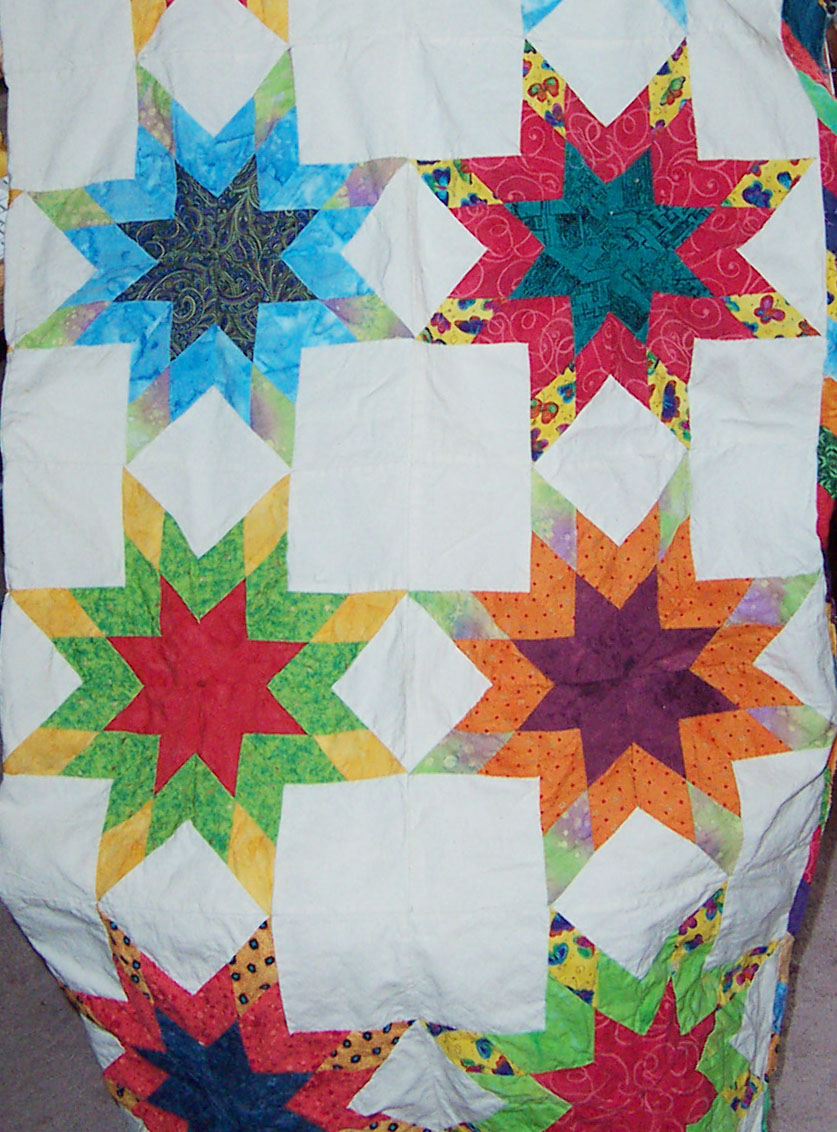
I showed you this last year — my very first quilt, which has been languishing in a closet forever. Obviously, I didn’t know how much I had to learn! There are some pretty obvious holes in the centres of those stars. I still love the colours I used in it though, and don’t want to just throw it out.


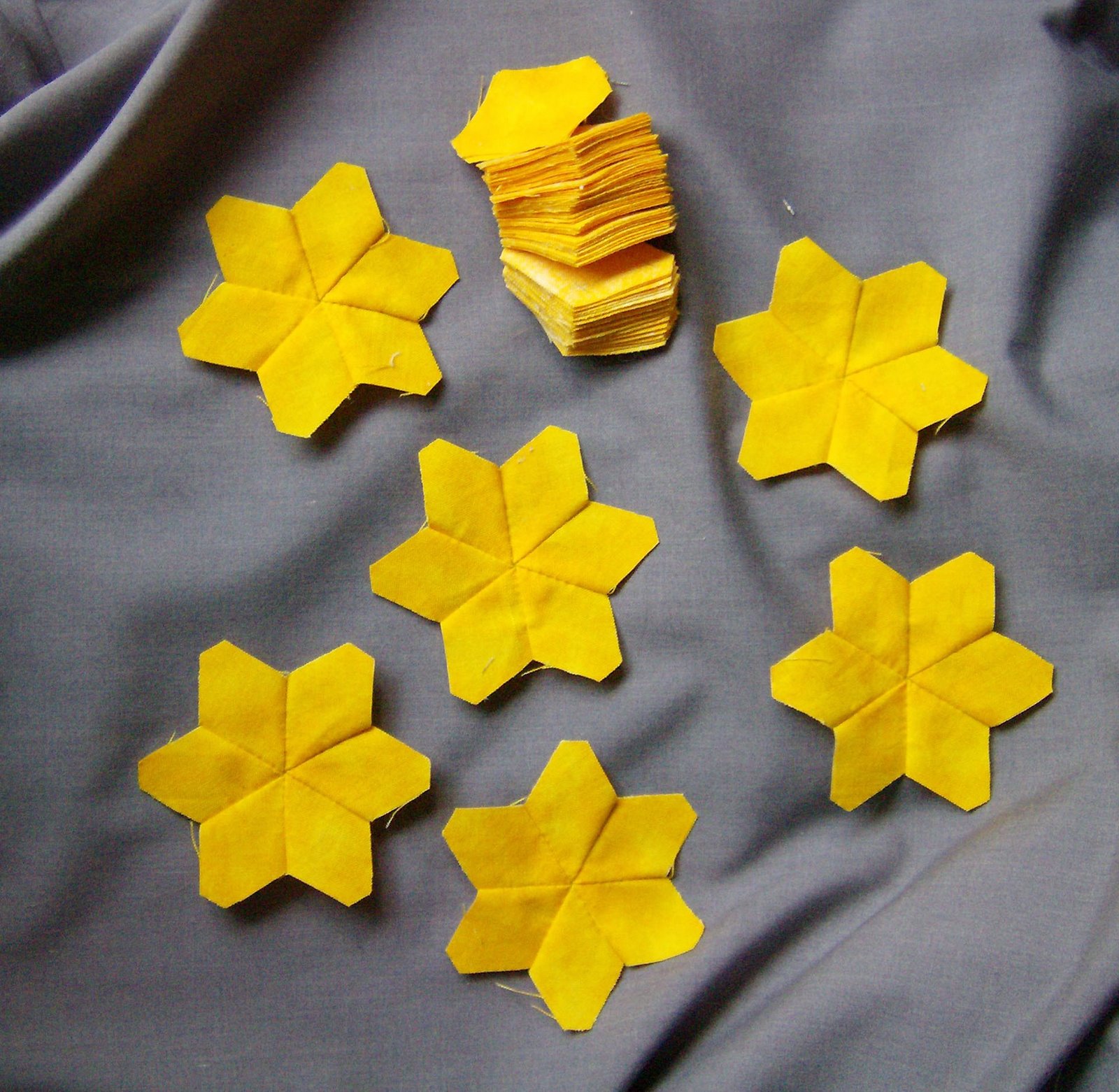
Rose Marie over at Applique ‘n Patch Quilting suggested I do a small star to applique on top of those centres. Brilliant! So we went on a hunt for the perfect yellow for the little stars. Found it. Printed a whole bunch of .75″ diamonds using Inklingo Collection 3 and started making the little 6-point stars. I think this is going to look fabulous when it’s done! It will be quite bright, which was the plan in the first place, and these little stars will cover the holes perfectly. Thanks, Rose Marie. Now to just finish making enough of them and applique them on — and then this will be ready to baste and quilt. 🙂

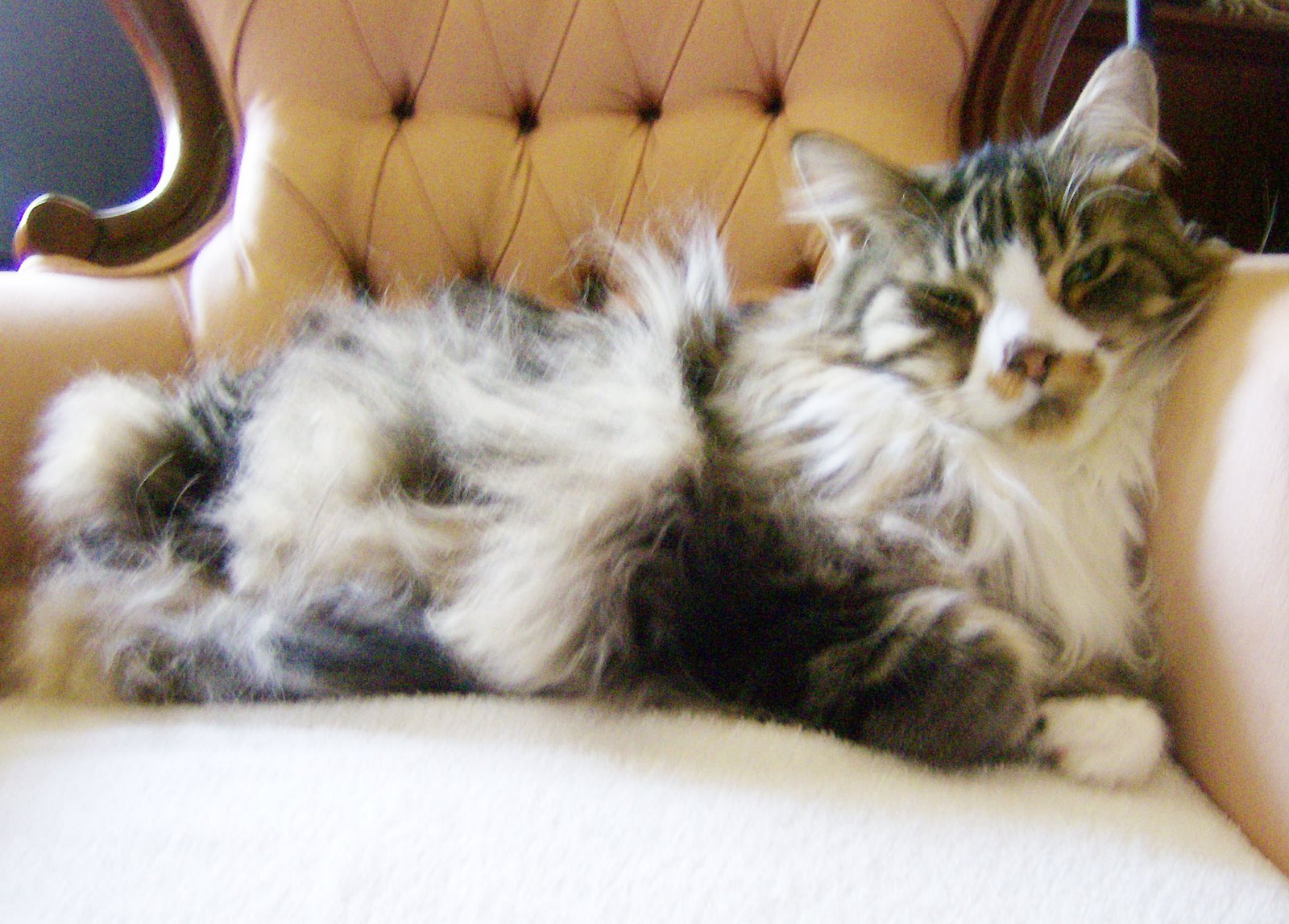
And, to finish off the week, yet another Smudge lounging pose. They are endless!